


Last Thursday, the Supreme Court ruled in a 6-3 decision that President Trump is not authorized to issue tariffs under the Interntaional Emergency Economic Powers Act (IEEPA) statute. This ruling blocks many of Trump’s signature tariff policies, including his February 1st tariffs on Canada and Mexico, and his April 2nd invocation of IEEPA otherwise known as “Liberation Day.” The latter announcement unleashed a universal flat 10% tariff on all imported goods, and tacked on reciprocal tariff rates topping out at upwards of 50% on some countries such as China, Vietnam, and Cambodia.
The Supreme Court’s ruling has numerous repercussions. First, the ruling raises questions about how to handle the series of trade deals that were negotiated after Liberation Day and rely on the now null IEEPA authority. The highest profile of these deals involves the European Union, which in late August committed to cut or eliminate tariff rates on U.S. seafood, agriculture, and industrial material exports and agreed to purchase a combined $1.3 trillion worth of U.S. energy products, semiconductors, and defense platforms. Japan is another example, pledging a total of $550 billion towards U.S. exports, and cutting tariff rates across the board. These deals are vast for good reason, as they were done in an effort to soften the Liberation Day blow. However, SCOTUS’s ruling leaves firms on the edge of their seats as it is unclear if negotiations will reopen.
It may take time for the future of Trump’s 2025 trade deals to become clear. However, the decision does raise one immediate question for US companies: are they entitled to reimbursement for profits lost to illegal tariffs? While Customs and Border Protection havean outlined protocol regarding refunds, SCOTUS did not weigh in on the potential idea of refunding those affected by the IEEPA framework. In total, experts estimate that close to $150 billion in duties has been collected by the U.S. due to IEEPA alone. This graph from the Cato Institute visualizes the impact IEEPA has had on U.S. importers.
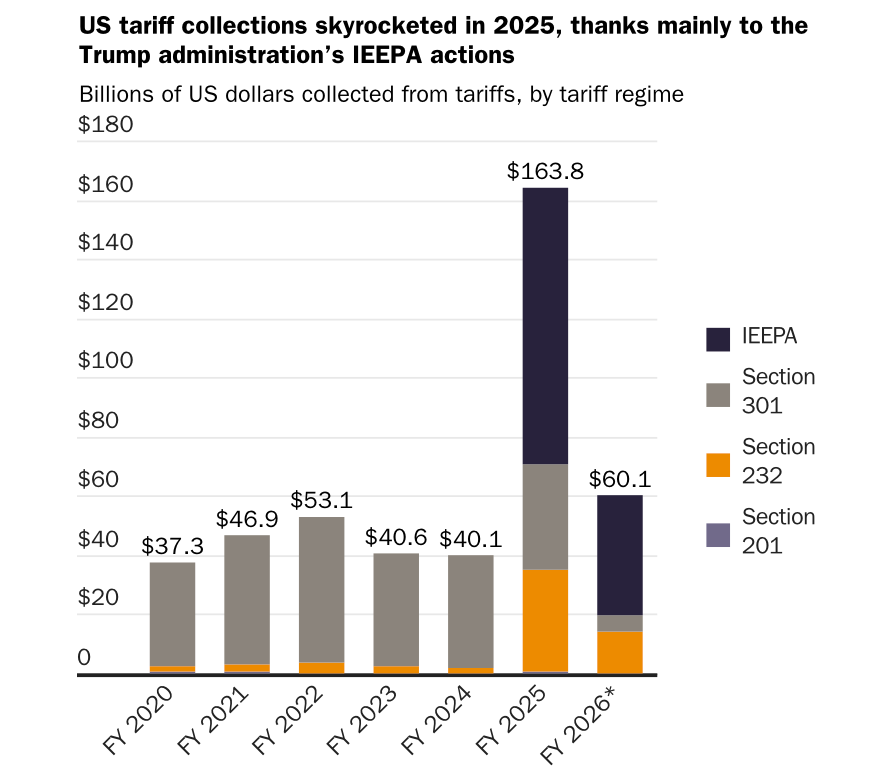
The economic burden of these tariffs largely fell on U.S. firms, with the New York Fed and U.S. Census Bureau calculating that by January-August, 94% of all tariff incidences fell on U.S. importers. If refunds are issued, the importer of record would receive the money. Although the importer of record paid the tariff, these firms are not necessarily those bearing the brunt of increased taxes because they can raise prices and thus pass costs down the supply chain. The National Bureau of Economic Research indicates as much as 20% of IEEPA tariff costs were passed through to buyers, meaning consumers felt much of the pain. Certainly, consumers and buyers cannot count on a drop in prices in the wake of this ruling. Even if refunds are issued, companies will be reluctant to change prices given uncertainty surrounding future trade policy.
