


China is the United States’ largest trading partner, and yet the two countries are in the midst of a trade war. As the Council on Foreign Relations states, “Economic tensions between Washington and Beijing have risen steadily over the past two decades as U.S. policymakers chart a progressively assertive course toward China.”1 This has become ever more prevalent today, with rising prices and pushes to diversify by the current administration.
A recent article by Bo Yang (University of Hong Kong), Jinyuan Song (George Mason University), Yifan Wei (Simon Fraser University), and Jing Li (Simon Fraser University) finds that even amid political pressure, both strategic and nonstrategic firms continued adding suppliers in China, with strategic firms adding new suppliers more slowly than nonstrategic firms. Importantly, political pressure still impacts firms, but they’re more inclined to stay if they gain significant revenue from China or rely heavily on Chinese suppliers. For these firms, walking away costs more than it’s worth, and that economic cost can outweigh the benefit of staying in the U.S. government’s good graces. The authors argue that the number of Chinese suppliers an American firm keeps is shaped both by its political leaning, with Republican-leaning firms derisking more, and by its concentration of supply networks and revenue derived from China. These patterns, they argue, are best explained by a legitimacy-efficiency tradeoff.
To investigate the issue, the researchers built their analysis around the legitimacy-efficiency tradeoff. Firms experience political pressure from home governments to derisk. If they don’t, they risk delegitimization, which can mean losing government contracts, financing, and research access. However, firms also have economic factors incentivizing them to stay in rival countries, from their revenue earned in that rival countries, to a high dependence on their rival country’s supply network. Ford’s decision to license Chinese technology for its U.S. electric vehicle battery plant demonstrates this tension. Ford’s move defied the push to diversify away from China, triggering months of congressional investigations and putting its eligibility for EV tax credits at risk. That’s the legitimacy-efficiency tradeoff at work: chasing one often means sacrificing the other, and Ford’s case shows just how costly that choice can be.
The research team conducted an observational study using data from the FactSet Revere Supply Chain Relationships database. Of the 513 firms in the sample, 138 firms in strategic industries served as the treatment group, and 245 comparable firms in non-strategic industries served as the control group. Using this data, they employed a DID Model, a method that compares how the treatment and control groups changed over time, to examine firms’ adjustments due to political risks. The model has two independent variables, Strategic Industries and Post-2017. Together, these create an interaction term that captures the heightened geopolitical risk strategic firms faced after 2017. Moderating variables include Share of Donations to Republicans, Share of Revenue from China, and Number of Sourcing Countries. Number of Chinese Suppliers serves as the dependent variable.
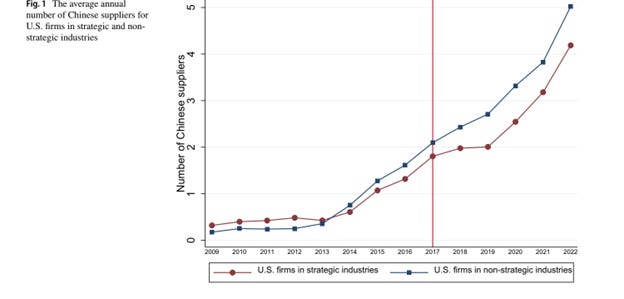
The authors’ results supported their legitimacy-efficiency tradeoff argument. The gap in the number of Chinese suppliers between strategic and non-strategic sectors was more pronounced after 2017 than before it, suggesting that a firm’s status as strategic or non-strategic shapes its diversifying decisions. However, a firm’s sector isn’t the only factor that shapes its decision. Between 2017 and 2020, during the first Trump administration, Republican-leaning firms in strategic industries were more likely to derisk by removing supply chain reliance on China than similar Democratic-leaning firms, reflecting their differing opinions on China at the time. After Biden took office, firms in strategic industries of all political leanings were more likely to diversify, reflecting a converged view on China across parties.
Economic incentives also factor into a firm’s decision to derisk. Since firms tend to source from countries where they generate significant sales, higher revenue from China made firms less likely to cut Chinese suppliers, even in strategic industries. Along the same lines, the difference in Chinese suppliers before and after 2017 was less pronounced among firms with a less diversified supplier network.
The findings suggest that firms will continue to balance legitimacy and efficiency, ultimately choosing what is best for their economic success. As this study shows, that balance shifts with the political moment firms exist within. Firms lean toward legitimacy when the political cost of staying tied to China is high, and toward efficiency when the economic cost of leaving is higher still. However, the implications of this paper go far beyond the business realm. While the legitimacy-efficiency tradeoff described here is limited to firms, it could plausibly extend to consumers as well, showing up as higher costs, limited access to materials, and slower innovation. Geopolitical tensions, in other words, don’t stop at the boardroom; they eventually reach the consumers who rely on the firms caught in the middle.
https://www.cfr.org/backgrounders/contentious-us-china-trade-relationship