


The chaotic disruption of oil transportation through the Strait of Hormuz has strangled global energy markets. With Brent crude trading at $114 per barrel and U.S. gasoline prices averaging $4.45 per gallon, consumers, producers, and governments alike find themselves looking for pathways to minimize exposure.
This kind of disruption is severe, but not new, even in recent memory. The Russian invasion of Ukraine triggered a comparable disruption in global energy markets, driving oil prices from roughly $70 per barrel in early 2021 to $120 per barrel by mid-2022. Western economies were forced to draw on strategic reserves and accelerated efforts toward energy diversification.
The market volatility of the past few years, and, in particular, past few months, has reinvigorated political urgency globally surrounding the adoption of renewable energy. Green energy capacity and deployment have reached historically high levels,already accounting for 88% of new power generation in the United States and China both.1
As demand for alternatives to oil in the form of green energy accelerates, it feeds directly into the evolving economic competition between the United States and China. Control over green technology supply chains has become a central axis of the Trade War and presents an important long-term consideration: How do the United States and China currently compare in their green energy capabilities, and what does the balance imply for the next phase of their strategic and economic competition?
At the same time, both countries have deployed industrial policies to shape domestic green industries. Despite harsh cuts enacted by the Trump administration, the Inflation Reduction Act provides subsidies tied to domestic production and allied sourcing, aiming to build resilient supply chains.2 In addition, “friendshoring” strategies such as the 2023 U.S.–Japan critical minerals deal illustrates the intensifying effort to restructure green energy supply chains around trusted partners.3 China, by contrast, has pursued a long-term state-led strategy. By combining subsidies, low-cost financing, and industrial coordination, China now accounts for over 80% of global solar manufacturing capacity and roughly three-quarters of global battery production.4 More importantly, China’s dominance extends upstream. It refines approximately 60% of lithium, 70% of cobalt, and nearly 99% of battery-grade graphite, creating deep dependencies even for diversified supply chains.5 This upstream control ensures that relocation of final assembly does not eliminate reliance on Chinese inputs.
China’s pricing power further reinforces its position. Supported by economies of scale and state backing, Chinese solar and battery products are often 20–30% cheaper than competitors.6 This allows firms to capture global market share while pressuring Western producers. China accounts for more than half of global renewable energy capacity additions.7 Globally, China’s reach extends through exports and infrastructure development. As the largest exporter of solar panels and electric vehicles, it has established a strong presence across developing markets.8 Through the Belt and Road Initiative, China finances and builds energy infrastructure abroad, embedding its technology within long-term development pathways.9
Green energy has rapidly emerged as a core arena of U.S.–China competition, further extending the Trade War into advanced manufacturing and innovative technologies. The United States has increasingly relied on tariffs and trade restrictions to counter China’s position. In 2024, the U.S. imposed tariffs of up to 100% on Chinese electric vehicles, citing unfair subsidies and national security concerns.10 The tariffs escalated further following the Trump administration’s “Liberation Day” announcement, peaking at 135%.11 In tandem, the U.S. has maintained long-standing section 301 anti-dumping and countervailing duties on Chinese solar products through the U.S. Department of Commerce.12 More recently, this approach has broadened beyond finished goods to upstream inputs critical to the green transition, including expanded tariffs on lithium-ion batteries.13 These restrictions follow tightening restrictions on Chinese semiconductors and advanced technology exports used in electrical systems and computing.14
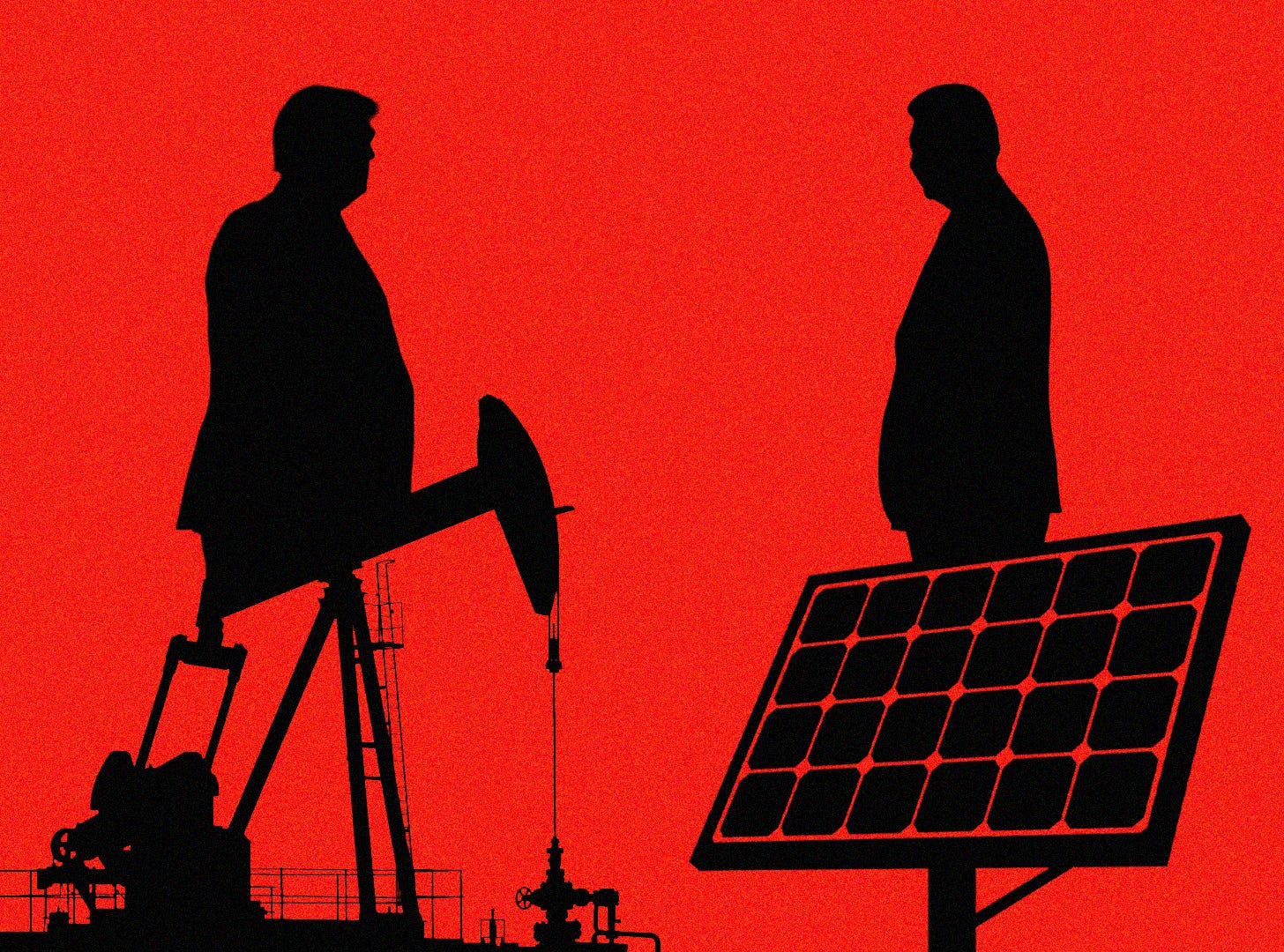
The two economic powerhouse’s positions on green energy expose a clear asymmetry: China dominates green energy manufacturing and upstream supply chains, while the United States is still working to buildout capacity and secure sourcing alternatives. Trump’s Iran policy, by contributing to oil market instability, is accelerating the global shift toward renewables—unintentionally strengthening demand in sectors where China has positioned itself as a leader. Ultimately, the political consequences of clean energy’s ascendance will depend on whether the United States can translate policy and alliances into scalable production before China’s advantage becomes too deeply entrenched.
“Renewable Energy Accounts for 88% of New U.S. Electrical Capacity in 2025.” Environment America Research & Policy Center, 10 Feb. 2026, environmentamerica.org/center/updates/renewable-energy-accounts-for-88-of-new-u-s-electrical-capacity-in-2025/. ; U.S. Energy Information Administration. “International - U.S. Energy Information Administration (EIA).” Www.eia.gov, 30 Sept. 2020, www.eia.gov/international/analysis/country/CHN.
Sjanifer. “Trump Orders Treasury to Axe Clean Energy Credit Guidance.” Thomson Reuters Tax & Accounting News, 11 July 2025, tax.thomsonreuters.com/news/trump-orders-treasury-to-axe-clean-energy-credit-guidance/.
“U.S.-Japan Critical Minerals Agreement.” Congress.gov, 2025, www.congress.gov/crs-product/IF12517.
Li, Xiaofeng, and Ming Du. “China’s Green Industrial Policy and World Trade Law.” East Asia, 24 Jan. 2025, https://doi.org/10.1007/s12140-025-09447-1. ; International Energy Agency. “Solar PV Global Supply Chains.” IEA, 2022, www.iea.org/reports/solar-pv-global-supply-chains/executive-summary.
Li, Xiaofeng, and Ming Du. “China’s Green Industrial Policy and World Trade Law.” East Asia, 24 Jan. 2025, https://doi.org/10.1007/s12140-025-09447-1
IEA. “The Battery Industry Has Entered a New Phase – Analysis - IEA.” IEA, 5 Mar. 2025, www.iea.org/commentaries/the-battery-industry-has-entered-a-new-phase.
Li, Ma, et al. “How China Adds More Renewable Energy than Any Other Economy.” World Economic Forum, 3 Dec. 2025, www.weforum.org/stories/2025/12/china-adding-more-renewables-to-grid/.
International Energy Agency. “Solar PV Global Supply Chains.” IEA, 2022, www.iea.org/reports/solar-pv-global-supply-chains/executive-summary. ; IEA. “Trends in the Electric Car Industry – Global EV Outlook 2025 – Analysis - IEA.” IEA, 2025,www.iea.org/reports/global-ev-outlook-2025/trends-in-the-electric-car-industry-3.
Xu, Lan. “Role of Belt and Road Initiative in the Development of Renewable Energy: Mediating Role of Green Public Procurement.” Renewable Energy, vol. 217, no. 118963, 1 Nov. 2023, p. 118963, www.sciencedirect.com/science/article/pii/S0960148123008698, https://doi.org/10.1016/j.renene.2023.118963.
Lawder, David. “US Locks in Steep China Tariff Hikes, Some Industries Warn of Disruptions.” Reuters, 13 Sept. 2024, www.reuters.com/business/us-locks-steep-china-tariff-hikes-many-start-sept-27-2024-09-13/.
Bown, Chad P. “US-China Trade War Tariffs: An Up-To-Date Chart.” Peterson Institute for International Economics, 27 Aug. 2025, www.piie.com/research/piie-charts/2019/us-china-trade-war-tariffs-date-chart.
Bhambhani, Anu. “US Continues AD/CVD Duties on China, Taiwan Solar Imports.” TaiyangNews - All about Solar Power, 13 Feb. 2026, taiyangnews.info/markets/us-continues-ad-cvd-duties-on-china-taiwan-solar-imports. Accessed 7 May 2026.
Ford, Neil. “Trump Tariffs, Orders Rein in Thriving Battery Storage Sector.” Reuters, 10 Mar. 2025, www.reuters.com/business/energy/trump-tariffs-orders-rein-thriving-battery-storage-sector-2025-03-10/.
“U.S. Export Controls and China: Advanced Semiconductors.” Congress.gov, 2025, www.congress.gov/crs-product/R48642.
