


Can a nation which is authoritarian at home be liberal abroad? This question is at the heart of a long-standing debate between scholars on whether China is a challenger to the liberal international order (LIO), or an insider working to reshape the order according to its interests.1 While many agree that the LIO was created and is largely adhered to by the United States, along with close allies in Europe such as the United Kingdom and France,2 fewer agree on China’s place within it.
Many scholars insist that China’s domestic authoritarianism must be incompatible with international liberalism. They emphasize that because a liberal order enables the US to have influence over China, China will always seek to shift or destroy this kind of international order.3 Other scholars caution against the narrative of China as a rising challenger to the LIO. Instead, they emphasize that China prefers to adopt a pragmatic approach, one which has more to do with selective adherence to the LIO than overall opposition. They argue that China is therefore a nation which is not fully a part of, but not against, the LIO.4
The legal enforcement of the LIO manifests itself most clearly in the United Nations Security Council (UNSC). In the UNSC, nations show their adherence to or antagonism towards the LIO by voting for or against cooperative sanctions on nations which have violated the LIO.5 The UNSC is the most coercive legal instrument available for three of its permanent members: the US, the UK, and France (the P3) to enforce liberal values internationally, yet they must avoid a veto by Russia or China, the two other permanent members, to successfully impose these sanctions. Thus, the P3 must decide either to include China in enforcing the LIO, or to exclude and work around China.
Dr. Jack Zhang and I looked into China’s adherence to the LIO from 1972 to 2024 using UNSC voting data from the Corpus of Resolutions: UN Security Council (CR-UNSC) dataset6 and from the Department of Political and Peacebuilding Affairs Security Council Vetoes (DPPA-SCVETOES) dataset.7 To find how much China’s voting pattern of “yes” votes, “no” votes, or abstentions adhered to the LIO, we used CR-UNSC voting data over imposed sanctions and DPPA-SCVETOES voting data over threatened sanctions, to construct a percentage measure of vote similarity based on that of Magu and Mateos (2017).8 We measured China as adhering to the LIO when it voted in agreement with the US, the UK, or France over sanctions enforcing the LIO. During the period of study, theP3 usually voted for sanctions enforcing the LIO and voted against sanctions going against the LIO.
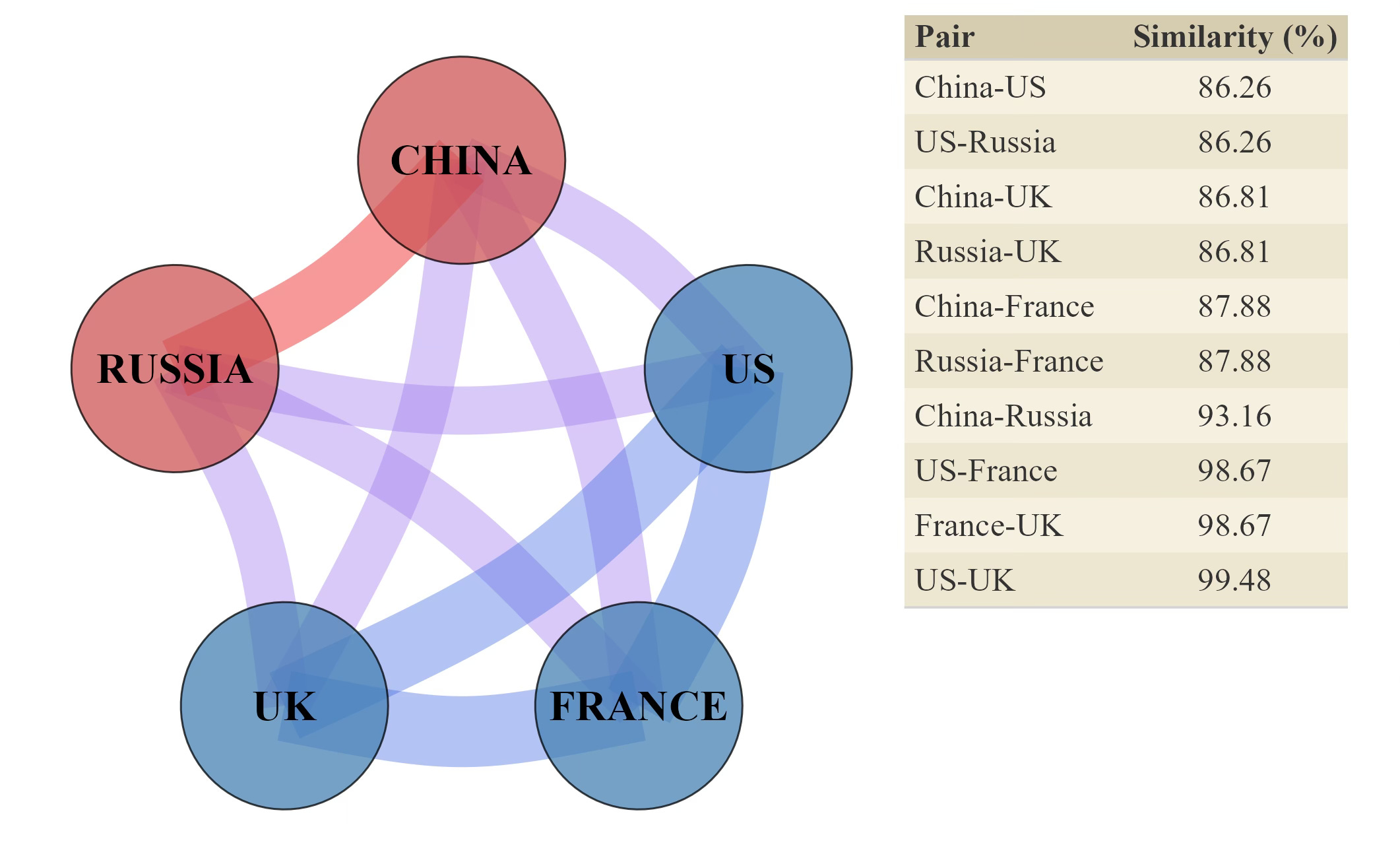
We found that in general, considering voting over all UNSC sanctions threatened and imposed for a multitude of reasons, China is highly similar to the P3 nations. China votes with the US, the UK, and France 86% of the time, 87% of the time, and 88% of the time, respectively, in support of these sanctions. China votes with Russia 93% of the time in supporting or opposing these sanctions, making it most similar to Russia and least similar to the US. However, the difference is small: only around 7 percentage points.
Somewhat more tension can be found between China and the P3 over sanctions enforcing the LIO. To analyze this in greater detail, we divided the LIO into two main non-economic suborders: the security order, concerned with maintaining national sovereignty while upholding international law, and the human rights order, concerned with maintaining human dignity as outlined in The Universal Declaration of Human Rights adopted by the UN General Assembly. China votes with the US, the UK, and France 83% of the time in support of sanctions enforcing the security order, and 82-83% of the time in support of sanctions enforcing the human rights order. Meanwhile, the P3 are more similar to each other than they are to China, with 99-100% similarity between any pair of the US, the UK, and France over the security order and human rights order. As such, the US, the UK, and France form a closer-knit group of internationally-liberal nations, but China is arguably internationally-liberal as well.
China is undoubtedly authoritarian at home, but abroad, at least within the UNSC, it does not work to undermine international liberalism. It supported the vast majority of UNSC sanctions supported by liberal nations like the US, the UK, and France to protect the international rule of law and the dignity of human persons. There is no reason to conclude that this agreement shows a deep appreciation by China for liberal values. Rather, that China is not as closely aligned with the P3 nations as they are with each other suggests that its international liberalism is pragmatic. China is a nation which the P3 can, and potentially must, work with to further their liberal foreign policies.
Of course, enforcing the liberal international order breaks down regardless of China’s position if the US, the UK, or France become antagonistic to international liberalism. Considering the latest foreign policy pivot of the US away from liberalism, this is by no means an uncertain prospect.
Xinbo, Wu. (2018). “China in search of a liberal partnership international order.” International Affairs, 94(5), 995–1018. DOI: 10.1093/ia/iiy141.
Lake, David A. (2020). “Whither the Liberal International Order? Authority, Hierarchy, and Institutional Change.” Ethics & International Affairs, 34(4), 461–471. DOI: 10.1017/S0892679420000611.
Beckley, Michael, and Brands, Hal. (2023). “China’s Threat to Global Democracy.” Journal of Democracy, 34(1), 65–79. DOI: 10.1353/jod.2023.0004.
Fung, Courtney J. (2019). China and Intervention at the UN Security Council: Reconciling Status. Oxford University Press.
Rees, Wyn, and Xu, Ruike. (2024). “US–UK–France Relations Amid the Russia–Ukraine War: A New Strategic Alignment?” International Affairs, 100(3), 1249–1261. DOI: 10.1093/ia/iiae075.
Fobbe, Seán, Gasbarri, Lorenzo, and Ridi, Niccolò. (2024). Corpus of Resolutions: UN Security Council (CR-UNSC). Zenodo. DOI: 10.5281/zenodo.11212056.
United Nations Department of Political and Peacebuilding Affairs. DPPA-SCVETOES. Peace & Security Data Hub. Available at: https://psdata.un.org/dataset/DPPASCVETOES.
Magu, Rijul, and Mateos, Gonzalo. (2017). “United Nations General Assembly Vote Similarity Networks.” Studies in Computational Intelligence, pp. 1174–1183. DOI: 10.1007/978- 3-319-72150-7_95

Why France but not Germany?