



When the U.S. Department of Commerce added Huawei to its Entity List in May 2019, most of the attention went to Huawei itself. Far less went to the companies around connected to Huawei such as the suppliers that sold it parts, the customers that bought its products, and the firms that shared its owners. Export controls are designed to hit specific targets, but modern supply chains rarely keep the damage neatly contained to the big target like Huawei. That raises a question for investors and policymakers alike: what happens to the companies standing next to a sanctioned firm?
According to a recent paper by Xin Gao, Can Guo, and Aiqin Hu (Anhui University of Finance and Economics),1 the answer shows up in their stock prices. The authors examine if U.S. export controls imposed on Chinese firms affect stock price fluctuations of affiliated Chinese companies economically connected to those sanctioned firms. Sanctioned firms are identified through the U.S. Entity List, maintained by the Bureau of Industry and Security (BIS) under the U.S. Department of Commerce, while the researchers establish affiliated relationships through ownership and supplier/customer records. Chinese firms placed on this list face licensing requirements and restrictions on access to controlled items like American technology. While most of the current academic literature focuses on companies directly targeted by export controls, the authors argue that this overlooks how other companies connected through supply chains and ownership relationships are affected. Companies not directly on the U.S. Entity List may still face economic consequences via stock price fluctuation, where the severity of these effects is dependent on firm size, risk-taking behavior, investor expectations, and more. This helps researchers and firms better understand how targeted restrictions can spill over onto affiliated companies and cause larger effects through interconnected industries than intended.
The authors predict that exposure to the Entity List will negatively affect affiliated companies’ stock prices. When a Chinese firm reduces its production or purchasing because of sanctions, suppliers experience loss in orders, revenue, or anticipated profits. One example was taken from Huawei’s inclusion on the Entity List after 2019, where its upstream semiconductor supplier SMIC suffered direct impacts through order reductions. Businesses purchasing products from these sanctioned firms might also experience limited access to components or increased prices. China’s large swathe of retail investors, who are prone to herding behavior, might also transmit uncertainty when expected future profits are ambiguous. This in turn lowers investor confidence, increases pessimism, and thereby influences decisions to buy or sell the shares. In short, the authors expect the Entity List to affect affiliated companies through two channels: business relationships and risk transmission. They also assess multiple factors that might intensify or weaken these effects, including firm size, R&D intensity, risk-taking capacity, and supply chain concentration.
To test this, the authors use a multi-period difference-in-differences (DID) research design, which treats Chinese companies’ inclusion on the U.S. Entity List as a quasi-natural experiment: the researchers did not choose which firms were exposed, a policy decision did. Simply put, this is a statistical technique which compares changes in an outcome over time between a treatment group and a control group. The treatment group is Chinese companies affiliated with sanctioned firms, and the control group is Chinese companies unassociated with sanctioned firms. Because “affiliation” is used a lot here, it is worth defining: a company counts as affiliated if it has an ownership relationship involving at least 25% of shares, or qualifying business relationships, such as reported major supplier or customer ties. The authors used 1,965 Chinese A-share listed companies from September 2018 through June 2022, combining month-by-month stock-market data with firm-level observations (firm size, R&D intensity, etc.). Exposure is measured by combining whether a firm is affiliated with a listed company and when its partner was added to the list.
To measure the effect on stock prices, the authors use cumulative abnormal return (CAR). Imagine a stock is expected to return 2% in a month based on market movements, but it actually returns -1%. Its cumulative abnormal return would thus be -3%, or three percentage points below its expected return. The authors calculate the monthly CAR by adding up the daily abnormal returns during each month.
The baseline results show that affiliated companies experienced approximately 2.8 percentage points lower monthly CAR following their partner firm’s inclusion on the Entity List, relative to the change among unaffiliated companies. In Table 2, column 4, the DID coefficient reads -0.0280, which is statistically significant at the 1% level. The authors see this as evidence of increased stock price fluctuations among affiliated companies. They also tested the parallel-trends assumption and found no significant differences in pre-sanction trends between the two groups. They then ran a placebo test 500 times using randomly assigned treatment groups and dates, where the estimated effects generally clustered near zero, further supporting their findings’ reliability.
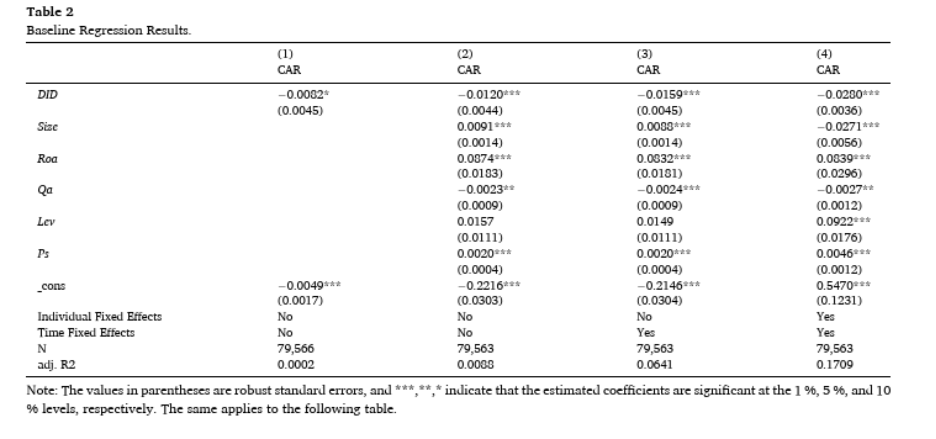
Baseline regression results from Gao, Guo & Hu (2026). The DID row in column 4 shows the 2.8 percentage point drop in affiliated firms’ monthly abnormal returns.
Now, the consequences of these stock price fluctuations aren’t uniform and largely differ according to firm characteristics. Smaller affiliated firms see a 3.62 percentage point drop, compared with 2.24 for larger firms. The authors suggest that larger firms are better equipped to withstand these shocks because they have greater financial capabilities and generally more supply chains and resources. Conversely, smaller firms lack many of these advantages, making them more prone to disruptions. High-liquidity firms also exhibit larger estimated effects (3.51 versus 2.36 points), and companies with lower R&D intensity are more affected (3.21 versus 2.57). This is because companies with higher R&D investment can more quickly adapt to disruptions through innovation and product deployment. These firms also tend to rely more on their own intellectual property rather than external suppliers. State-owned firms present an estimated 3.49 point effect, private firms show 3.44, and there was no statistically significant effect for foreign-invested firms. The authors suggest that foreign-invested firms may be more resilient because they often have diverse global supply chains, thus allowing them greater flexibility in finding alternative suppliers.
For tech companies, the authors use a triple difference model (difference-in-differences-in-differences) to see if effects differ for tech affiliates. The reported effect was an additional 4.23 percentage points, though the result is only significant at the 10% level, so it should be read with some caution. The authors attribute this to high-tech firms’ dependence on specialized technologies and components that are difficult to replace. Semi-conductor suppliers are not as easily available as, say, textile suppliers. In short, the results make a presentable case of why some firms are more vulnerable than others, dictated by exposure to sanctions, business dependence, organizational characteristics, and financial support.
The research also examines the mechanisms behind these effects. The first is supply chain concentration, wherein firms heavily dependent on a small number of suppliers or customers experience greater disruptions when their partners are restricted. The second is investor sentiment. They find that Entity List exposure reduces their investor sentiment index by approximately 0.120 units, suggesting that uncertainty can weaken investor confidence and, in turn, stock prices. In addition, they find that government subsidies can mitigate the adverse effects of export controls on high-tech affiliated firms. Put together, these mechanisms suggest that a firm’s economic relationships, investor expectations, and currently available financial support influence how strongly export controls affect it.
The synthesis of all this data, their findings, and their conclusions strongly suggest that U.S. export controls have indirect financial effects on affiliated Chinese enterprises. The authors’ findings leave corporations with a plan of action: diversify suppliers to lower supply chain concentration, mitigate dependence on individual partner companies, and strengthen resilience to external shocks by improving their risk-taking capacity, which the authors suggest can be done through stronger management and regular risk assessments. The conclusions also present several policy implications. Because high-tech firms often depend on specialized technologies or components that are difficult to replace, a recommendation is made to strengthen R&D investment and support firms in adapting to export control shocks. Directly or indirectly affected Chinese companies should also actively align themselves with national policies, and promptly prepare for timely transformations and upgrading, which will enhance their risk resilience.