



Global Value Chains (GVCs) are an integral part of the modern economy. A GVC is achieved when the production of a single good is broken down across countries before reaching its destination. From the textile mill to the rack at Macy’s, companies up and down these GVCs have a common interest in the entire system running smoothly: disruptions at any point can affect their business, even when the disturbance does not directly involve their own imports or exports. Despite this interdependence, most theories expect firms to organize at the industry level to oppose trade barriers, or, more recently, large firms lobby individually to protect their own products.
A recent article by Hao Zhang (Princeton University) seeks to explore how GVCs have fundamentally changed the way firms form trade coalitions and lobby. The author presents a new theoretical framework where GVC linkages serve as an important determinant of trade preferences and collective political action. This framework starts from the basis that industries and firms do not exist in isolation, instead they are interconnected through various production linkages.
Zhang’s theory begins with the idea that there are “upstream” producers who make input products (ie. textile mills), midstream producers who take those raw good from the upstream producer and shape them (ie. using textiles to manufacture clothes), and finally downstream producers who distribute the product produced by the midstream firm (ie. retailers selling clothes). Using the apparel example, one might assume that an upstream firm producing and selling textiles abroad is unaffected by tariffs downstream firms pay to import clothes. Except in the GVC model, they are. Zhang notes that the whole system is integrated, meaning upstream producers lose business if companies down the line face higher costs, and downstream companies are in trouble if their imports get more expensive. Thus, Zhang theorizes that we should expect to see companies across GVCs lobby for free trade. This is why we see textile manufactures lobby against tariffs on clothing imports. Further, coordination barriers should be lower for firms in integrated supply chains. These companies are already coordinating constantly, making it easier to organize across GVCs than within industries, where firms must cooperate with competitors.
The dataset compiled by the author to support this framework empirically is made up of firm-to-firm supply chain networks for public US firms from 2003 to 2020. This data was compiled using millions of public intercompany relationship records published on FactSet. Connecting this data with over 82,000 lobby reports on trade and tariff issues, Zhang shows that GVC firms tend to lobby together (that is, they lobby at the same times that their GVC partners are lobbying), lobby on the same bills, and hire the same lobbyists. In fact, the probability that a firm with an average number of GVC partners lobbying will also lobby is roughly double that of a firm with no GVC partners actively lobbying. The author also demonstrates that, in industries with high levels of GVC integration among leading firms, the probability of collective industry lobbying increased from almost 0% to 30%.
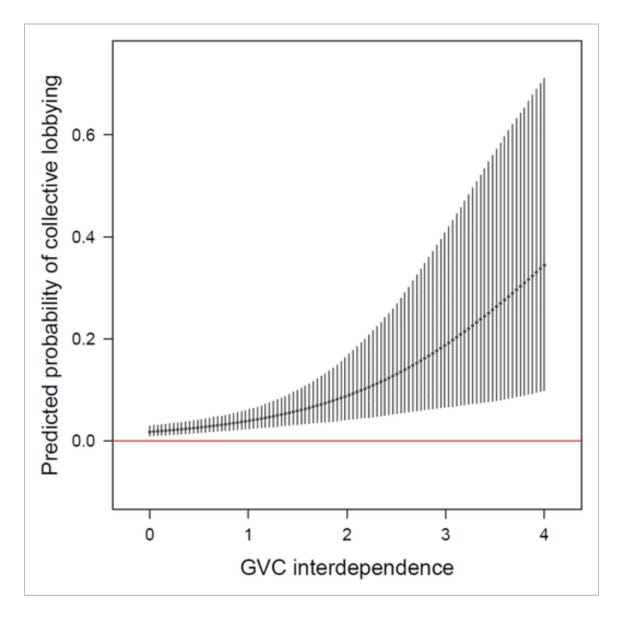
In addition, the author suggests that GVC linkages extend beyond coordinated lobbying to shaping actual policy. The author uses the case of preferential trade agreements (PTAs) to illustrate this effect. According to the data presented, two countries that exist withinthe top 10% of values in GVC linkages are over 50% more likely to form new PTAs than countries that exist within the bottom 10%. Zhang argues that this shows GVCs play a significant role in driving the demand for trade liberalization during the height of global production.
Companies do not exist in isolation, effected only by trade restrictions on products they buy and sell. Instead, firms are concerned with trade policy up and down their supply chains. Zhang’s evidence suggests that businesses coordinate along GVCs because they share common interests, and existing communication structures between firms on the supply chain makes it easier for them to organize. This theory provides a new way of thinking about coordinated corporate influence that goes beyond an individual firm’s or industry’s influence.
