


When countries clash today, they increasingly reach for economic sanctions rather than weapons. One of the biggest users of this strategy is the United States, which imposes more sanctions than any other country. Although this is true, the U.S. Department of the Treasury’s Office of Foreign Assets Control (OFAC), the federal agency that administers and enforces U.S. economic sanctions, has limited resources and needs to enforce sanctions in the most effective and cost-efficient way possible. Based on the evidence gathered, it’s argued that this enforcement approach targets high-profile firms, visible ‘whales’ generates more deterrence per enforcement action than pursuing many smaller violators.
A recent paper by Keith A. Preble (Miami University, Oxford) and Bryan R. Early (University at Albany, SUNY) finds evidence that shows the OFAC enforces sanctions by focusing its efforts on giving larger penalties for high-profile compared to low-profile firms. Specifically, large penalties occur with foreign high-profile firms. They theorize that this is due to high-profile firms having large reputations that, with this naming-and-shaming policy, would prompt mass media coverage and lasting reputational damage to the companies being targeted. The authors argue that the media attention generated by these actions is meant to create a ripple effect, with other, smaller companies adhering to the sanctions to avoid the same fate reported on. These findings, gathered by the researchers, show how the U.S. has been enforcing company sanctions with the limited resources of the OFAC.
To investigate their question the researchers first theorize that the U.S. is more likely to inflict larger penalties on high-profile firms, rather than low-profile ones. Secondly, they theorize a ‘name and shame’ effect, where publicizing a fine against a well-known firm materially harms its reputation, translating into lost investor confidence and weakened business relationships. This is believed to be the strategy of the OFAC due to the cognitive heuristics of availability bias and probability neglect. Due to availability bias, if high-profile firms are to be reported more often than low-profile firms, it means smaller companies are more likely to remember or hear about these instances, which may create fear among them. The probability that they, as low-profile firms, will be fined is low compared to high-profile firms; however, due to probability neglect, though, the companies still fear penalties against them and change their actions in order to avoid the possibility.
To test these two theories, the researchers gathered data on 207 firms, both foreign and domestic, and separated them by the level of profile of each firm. The researchers then went on to calculate, on average, how much the firms were fined, shown in Table 2a and Table 2b. To test their second theory on media traction on high-profile companies, the researchers used LexisNexis to gather the number of news reports made on a high-profile firm, Berkshire Hathaway, that was fined $4.14 million, and compared it to a low-profile firm, Generali Global Assistance, that was fined $5.86 million (Figure 3).
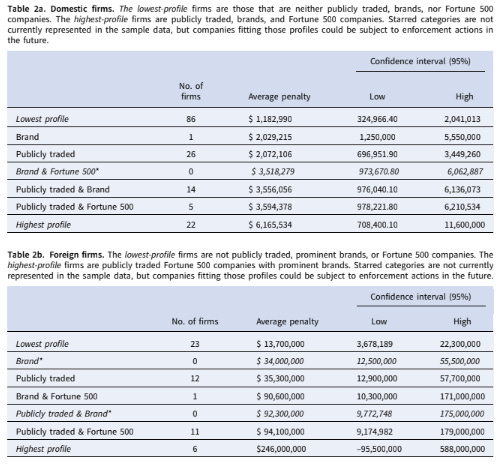
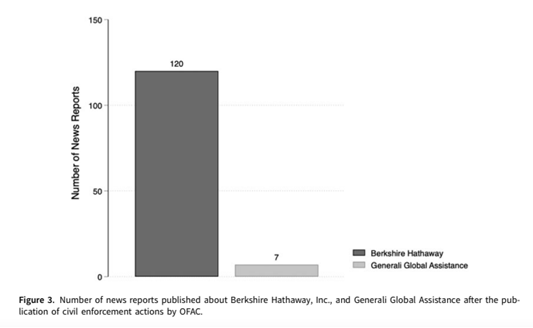
In Table 2a and Table 2b, the data show a large difference in the costs of repercussions faced by low-profile firms and high-profile firms. High-profile domestic firms were fined about 6 times more than their low-profile counterparts, and high-profile foreign firms were fined about 18 times more. This table shows that not only are high-profile firms fined a greater cost than low-profile firms, but it also shows that foreign firms are fined more than domestic, due to foreign firms requiring higher penalties in order to gain media attention in the U.S. In order to explain why high-profile firms are fined more than low-profile ones, the researchers used the gathered data from LexisNexis, seen in Figure 3. Figure 3, which compares the number of news reports made over a high-profile firm, Berkshire, being fined in comparison to a low-profile firm, Generali, shows that Berkshire had 113 more reports made than Generali’s 7 reports, despite the fact that Berkshire was fined about $1.7 million less than Generali.
This data shows the tactics used by OFAC to enforce government sanctions on companies. Due to the limited resources granted to the OFAC, achieving maximum compliance with minimal action is important, as seen in who they target. High-profile firms are being fined at a significantly larger amount than low-profile firms, in order to foster as much media attention as possible. This action is intended to damage the company’s large reputation, with lasting effects. At the same time, the authors argue that the media coverage gained from these actions is meant to push lower-profile firms to change their ways in order to adhere to sanctions, due to the fear of being met with the same repercussions. Although evidence shows the theories created seem to be true, the actual after-effect isn’t reported in the paper. Whether or not smaller firms change their actions due to high-profile firms being targeted has yet to be proven. Instead, the behavioral response is inferred from the heuristics of availability bias and probability neglect. So while Preble and Early show that OFAC does target high-profile firms with larger fines, the paper doesn’t directly test whether that strategy actually changes how other companies behave, which is a link future research would need to confirm.