



The trade relationship between the United States and China has grown to become one of the largest in modern history. By 2016, bilateral trade had reached $578 billion; however, the U.S. imported substantially more goods from China than it exported. During the 2016 presidential election, Donald Trump campaigned on a promise to challenge China’s trade practices and reduce the trade deficit. Between 2018 and 2019, his administration imposed tariffs ranging from 7.5% to 25% on nearly two thirds of all U.S. imports from China. The tariffs put pressure on U.S. firms to sever ties with Chinese suppliers or pay the tariffs themselves. Leaving China, however, was not a simple task. For many products, there was nowhere else to go. So, which firms are able to walk away?
In “Allied import options available? Finding friendly trade partners amidst decoupling from China,” Ayse Eldes (Princeton University), Jieun Lee (University at Buffalo), and Iain Osgood (University of Michigan) investigate what allows U.S. firms to cut ties with Chinese suppliers as pressure to decouple increases. Decoupling occurs when two countries that were previously economically interdependent begin to weaken or sever their economic ties. The authors argue that a firm’s ability to leave China depends on whether it can buy the same products from allied or friendly countries.
According to the authors, there are three main challenges to decoupling. First, the cost of switching suppliers can involve a lengthy search for new markets, ending contracts, and disrupting production, all of which can be too great for some countries. These costs can be even higher for U.S. firms that own manufacturing facilities in China, which account for roughly a quarter of U.S. imports from China. Second, a feasible alternative host market or supplier could be nonexistent. Manufacturing tends to settle in a few places, and China’s “external economies of scale” give it advantages that are difficult to replicate. The third challenge and core contribution of the paper is finding an alternative supplier that does not recreate the same political risk that came with an integrated U.S.-China economy. Since the push to decouple is political, moving production from China to another U.S. rival may simply trade one set of risks for another. Allies, by contrast, are less likely to go to war with the U.S., so trade with them “should remain free if hot conflict emerges.”
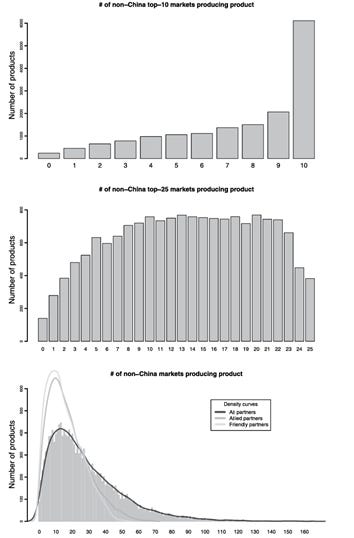
Figure 1. The availability of alternative suppliers varied across products, with fewer allied and friendly alternatives than total non-China alternatives. Source: Eldes, Lee, and Osgood (2026), Figure 2.
To test their argument, the authors used product-level data on U.S. imports. For each product they counted how many other countries were already selling each product to the U.S. between 2012 and 2016, before the trade war began. They then compared how imports from China changed after the tariffs for products with many existing alternative suppliers versus products with few or none, looking at two periods, 2018 to 2020 and 2021 to 2023. To test whether political relationships mattered, they sorted these alternative suppliers into allied countries, those with a defense, offense, or neutrality pact with the U.S. active in 2018, and friendly countries, those that generally vote the same way as the U.S. in the UN General Assembly. Finally, they used data on tariff exclusion requests to see whether firms without alternatives were more likely to push back against the tariffs.
The authors found that having other options made a sizeable difference. Between 2018 and 2020, imports from China fell roughly 29-34% more for products already supplied by all 10 top trading partners, than for products supplied by none. From 2021 to 2023, this gap grew to 40% or more. However, not every alternative was equally useful. Doubling the number of allied suppliers was associated with an 11-14% larger decline in imports from China, growing to 15-20% in the later period, and friendly suppliers had a similar effect. Non-allied and unfriendly alternatives had no statistically significant effect. This suggests that U.S. firms were more capable of reducing their reliance on China when they already had politically safe countries supplying the same products.
Eldes, Lee, and Osgood show that tariffs on their own cannot force U.S. firms to decouple from China. Notably, their contribution points out that firms need both a reason to leave, and somewhere safe to go. Where allied or friendly suppliers already existed, imports from China fell sharply and kept falling. Where they did not, firms stayed tied to Chinese suppliers and turned to the USTR for relief. The findings suggest that decoupling from China will be slow and uneven, and concentrated in products with safe substitutes. For policymakers, the paper points to a broader lesson of building trade tied with allied and friends to help reduce the dependence on China.
Well done! I appreciate how digestible it was for someone not in the field to follow.
Fantastic job, Isabela!