


Blaming China has become one of the few things Democrats and Republicans agree on. Donald Trump built a political brand around it. Joe Biden kept Trump’s tariffs in place and added new ones on Chinese EVs, solar cells, and steel.1 By 2024, 171 campaign ads for congressional or presidential candidates mentioned China.2 The prevalence of this rhetoric raises an important question: What benefits do politicians reap from using anti-China rhetoric? More specifically, is it possible that pointing the finger at Beijing lets politicians off the hook for domestic failures?
As a research assistant for the KU Trade War Lab, I worked on a project that used two waves of KU Trade War Lab survey data to test whether using rhetoric that frames foreign rivals as the cause of American problems shifts blame away from US politicians, or simply causes people to blame both geopolitical rivals and domestic political actors. The survey experiment employed 2,578 U.S. adults combined (1,218 in 2020 and 1,360 in 2025) and randomly assigned respondents to see either China or Japan on a select-all blame attribution question asking who is responsible for the country’s current economic problems, with Japan serving as the control. Respondents could assign blame to the president, Republican Congress, Democratic Congress, Canada, Mexico, China or Japan, corporations, unions, or no one, and they could select as many targets as they wanted. From these responses, I constructed four outcomes: Foreign (selecting at least one foreign actor), Domestic (at least one domestic actor), Both, and No one.
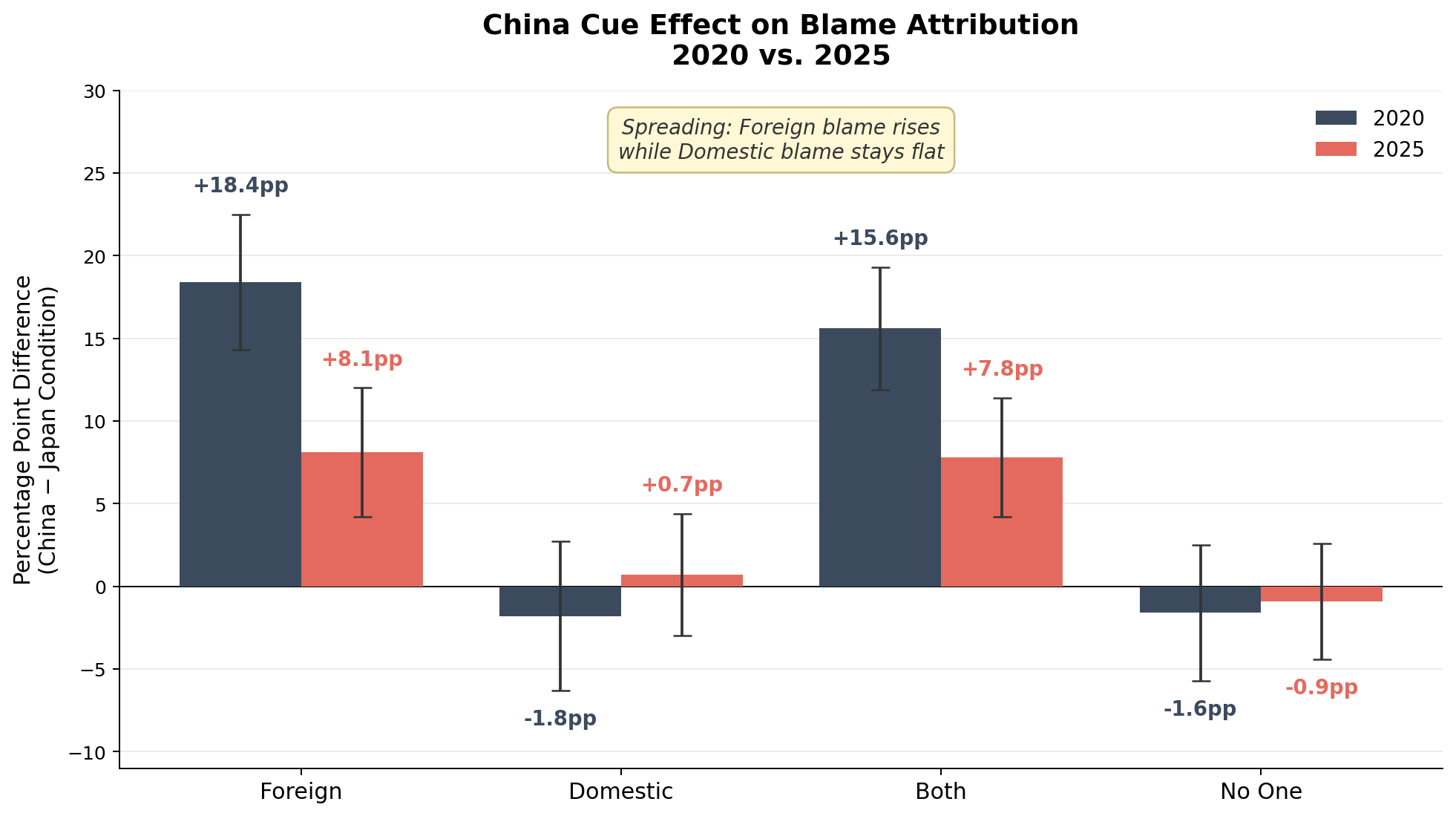
The preliminary results support the theory that blaming foreign rivals “spreads” political blame attribution rather than “shifts” it to foreign actors alone. The share of respondents who named at least one domestic actor barely moved, sitting 1.8 percentage points lower in the China group compared to the Japan group in 2020 and 0.7 points higher in 2025, and neither difference was statistically distinguishable from zero. Having the option to name China raised foreign blame by 18.4 percentage points in 2020 and 8.1 percentage points in 2025 relative to the Japan condition. The “Both” category, respondents who blamed foreign and domestic actors simultaneously, also rose sharply when respondents were given the option to blame China, by 15.6 percentage points in 2020 and 7.8 in 2025. Voters who saw China on the list blamed foreign actors at much higher rates than those given the option to blame Japan, but did not reduce the blame they placed on the president, Congress, or any other domestic target. They added a target without subtracting one.
The partisan breakdown tells an interesting story about how the effect of being presented with the option to blame China effects people’s tendency to attribute domestic problems to foreign actors. In 2020, Republicans drove nearly all of the foreign blame effect. Having the option to name China increased Republican foreign blame by 30.8 percentage points relative to Republicans who saw Japan, a far larger increase than among Democrats or Independents, and this difference was highly significant (p<.001). By 2025, that partisan gap had largely closed. Naming China as a potential cause of domestic problems now raises foreign blame attribution among Democrats, Independents, and Republicans by roughly the same amount. This may reflect the normalization of U.S.-China conflict across both a Democratic and Republican administration. Anti-China rhetoric is no longer a distinctly Republican signal.
My preliminary finding that naming China spreads blame rather than shifts it has consequences for how we think about democratic accountability. Politicians who blame China may not be successfully deflecting responsibility for economic outcomes. Instead, they could be expanding the set of actors that voters hold responsible without reducing the pressure on domestic leaders. The added effect of naming China was smaller in 2025 than in 2020 (8.1 versus 18.4 percentage points), which may suggest that the larger 2020 effect owed much to the COVID-19 pandemic, when China was front-of-mind as the origin of the virus, and that by 2025 the effect of the pandemic had faded, but anti-China rhetoric was still strong enough that people blamed the country for domestic issues. The core pattern that respondents tended to blame China along with domestic actors held across both waves and across five years of very different political environments.
This project could be improved in several ways. The two waves are not identical samples, so comparisons over time partly reflect differences in who responded. The blame measure is also a single select-all item, which captures whether respondents name an actor but not how strongly or why. Future work could examine which domestic actors absorb blame alongside China and test the patterns across education as well as party.
NPR, “Biden announces new tariffs on Chinese EVs, semiconductors and other goods,” May 10, 2024, npr.org/2024/05/10/1250670539.
NPR, “Tens of millions already being spent on campaign ads naming China,” November 15, 2023, npr.org/2023/11/15/1212875400.