



Since the launch of Reform and Opening in the late 1970s, China has become deeply integrated into the international system and increasingly active within major international organizations (IOs). As China’s economic and political influence has expanded, scholars have debated whether Beijing seeks to revise the liberal international order or instead works pragmatically within existing institutions. One perspective argues that China aims to reshape or weaken liberal norms and institutions1, while another contends that Chinese leaders view participation in international organizations as beneficial for advancing national interests2 without fundamentally overturning the existing order.
Despite extensive debate, there remains little consensus regarding how Chinese elites themselves view international organizations and China’s role within them. One reason is that most studies focus on China’s behavior in international institutions rather than how Chinese leaders publicly frame those institutions. Official media provides a useful window into these attitudes because it reflects the priorities and narratives promoted by the Chinese Communist Party (CCP).
This project builds on a dataset created by the Trade War Lab that tracks foreign coverage in People’s Daily articles3. Li et al (2025) finds that the newspaper functions as a source of information and as a mechanism for signaling leadership priorities and foreign policy narratives. As Chinese leaders consolidate power, foreign coverage becomes increasingly focused on articulating official policy positions rather than simply reporting events abroad. Figure 1 illustrates that mentions of major foreign powers, such as the United States, Japan, Russia, the United Kingdom, and France, remained relatively stable from the early 1990s through the mid-2010s. Beginning around 2016, however, coverage of all five countries declined sharply, with references to the United States falling particularly dramatically. This decline occurred despite growing geopolitical competition and China’s increasingly active role in international affairs, suggesting that changes in People’s Daily coverage may reflect shifts in propaganda priorities rather than the objective importance of foreign countries.
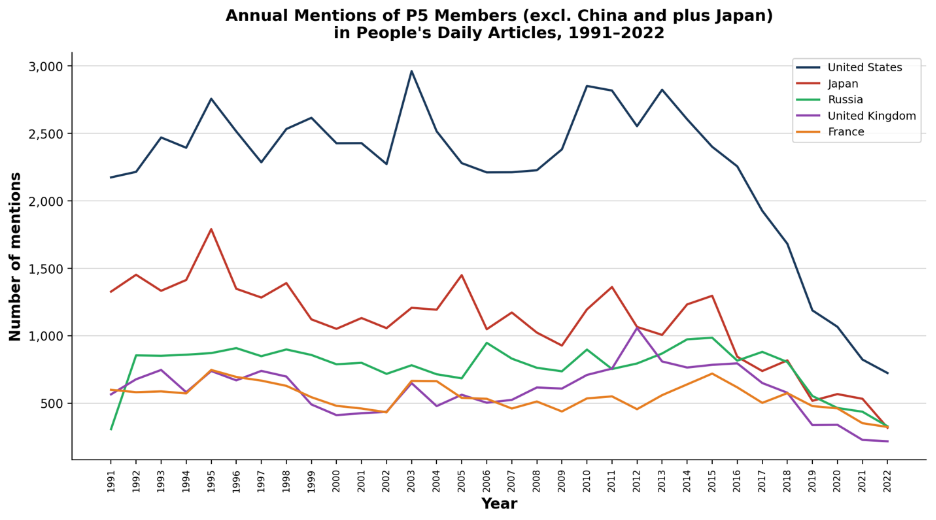
Building on these findings, this study examines how Chinese state media frames key international organizations, offering a window into elite understandings of global governance and China’s place within the international order. I conducted a preliminary textual analysis using Li et al.’s (2025) data to identify articles mentioning the United Nations (UN), World Trade Organization (WTO), International Monetary Fund (IMF), World Bank/ International Finance Corporation (IFC), and the World Health Organization and drew a small random sample of articles about each for qualitative content analysis. While limited in scope, this approach provides an initial assessment of how Chinese state media frames major international organizations.
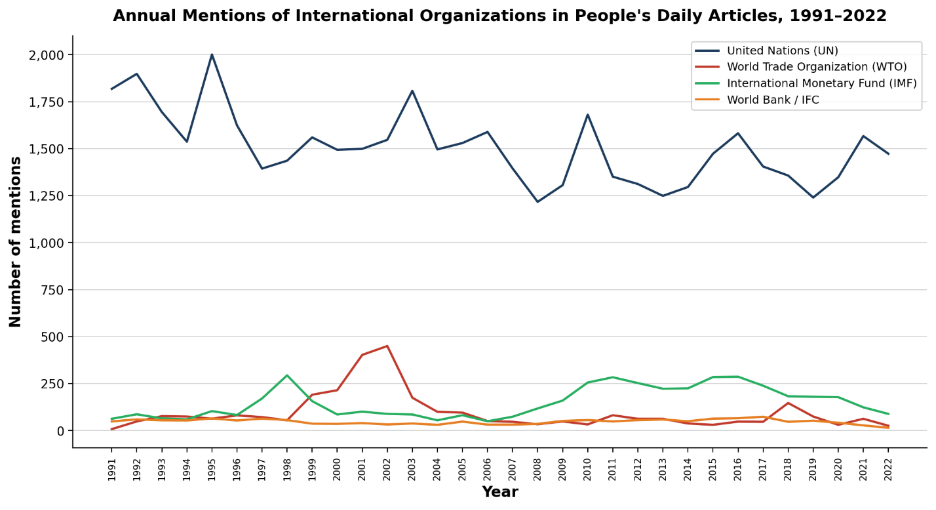
Figure 2 places coverage of major international organizations (IOs) in comparative perspective. Unlike coverage of major foreign powers—which declined sharply after the mid-2010s—mentions of international organizations remained relatively stable. References to the United Nations consistently exceeded 1,200 annual mentions throughout the period, surpassing the coverage of every individual foreign country except the United States. Coverage of the IMF and WTO fluctuated substantially, peaking during the Asian Financial Crisis (1997) and China’s accession (2001) debates, but remained well above 1990s levels through much of the 2010s. This relative stability is notable because it contrasts sharply with the dramatic decline in People’s Daily coverage of major Western powers documented by Li et al. (2025). Coverage of major international organizations remained comparatively resilient and suggest that IOs continued to occupy an important place in official discourse during the Xi Jinping era.
A qualitative review of sampled articles helps explain this pattern. International organizations were generally framed positively and associated with themes of world peace, economic development, international cooperation, and multilateral governance. Discussions of reform focused on improving representation for developing countries, increasing institutional effectiveness, or strengthening global cooperation rather than questioning the legitimacy of the organizations themselves. When China’s interests were discussed, they were typically presented as compatible with broader international goals. Coverage of the World Bank and IFC, for example, frequently highlighted the role of development finance in promoting economic growth and shared prosperity.
Together, these findings provide preliminary evidence that Chinese state media does not portray the pillar IOs of the liberal international order as obstacles to China’s rise. Rather, they are generally depicted as useful platforms through which China can advance its interests in a multipolar world4. The findings also point to a broader narrative of growing Chinese confidence in its international role. Contrary to expectations that Beijing seeks to bypass or replace existing organizations through new institutions such as the Asian Infrastructure Investment Bank (AIIB), People’s Daily coverage suggests a strategy of engagement and influence within major IOs rather than seeking to dismantle them. At a time when the United States has become more skeptical of multilateralism, Chinese state media increasingly presents leadership in international organizations as both beneficial to China and essential for global governance.
While this exploratory analysis cannot resolve broader debates about China’s long-term intentions toward the liberal international order5, it is more consistent with interpretations that emphasize adaptation and engagement rather than outright rejection. More broadly, the findings illustrate the value of official media as a source of evidence about elite attitudes toward global governance.
Weiss, J. C., & Wallace, J. L. (2021). Domestic Politics, China’s Rise, and the Future of the Liberal International Order. International Organization, 75(2), 635–664.
Johnston, Alastair Iain. Social States: China in International Institutions, 1980-2000: China in International Institutions, 1980-2000. Princeton University Press, 2008.
Li, J., Zhang, J. J., Jiang, D., & Zhong, W. (2025). Domestic Politics and Editorial Control Over Foreign News Coverage in the People’s Daily, 1993–2022. Journal of Contemporary China, 1–17. https://doi.org/10.1080/10670564.2025.2486329.
Schweller, Randall L., and Xiaoyu Pu. "After unipolarity: China's visions of international order in an era of US decline." International security 36.1 (2011): 41-72.
Kang, David C., Jackie S. H. Wong, and Zenobia T. Chan; What Does China Want?. International Security 2025; 50 (1): 46–81. doi: https://doi.org/10.1162/ISEC.a.5.
