



Every round of the current trade war forces the same choice. A government can chase prosperity, open markets, and let supply chains find the cheapest producer, or it can chase security, wall off strategic industries, and pay the price. Tariffs, export controls, and new economic security pacts demand that governments choose either wealth or power. The dilemma sounds like a product of the present, but it echoes a much older argument in economic history: whether wealth and power were ever really rivals. Three centuries ago, statesmen wrestled with a version of the same question, and one economist’s answer to it is still worth reading today.
Mercantilism, the body of trade doctrine that guided European statecraft before Adam Smith, has long been read by historians as a system organized around power, in which a ruler hoarded bullion and weakened his rivals to strengthen the state. At the same time, wealth served only as a means, the treasure that funded the fleets and the soldiers. That reading became the standard consensus: power came first, wealth second. But did the mercantilists actually treat wealth and power as rivals, or has that assumption said more about later interpreters than about the mercantilists themselves? In “Power versus Plenty as Objectives of Foreign Policy in the Seventeenth and Eighteenth Centuries,” Jacob Viner (Princeton University) challenges this consensus about mercantilism. Writing in the inaugural 1948 issue of World Politics, Viner argued that the mercantilists never ranked the two goals against each other; in their thinking, power and plenty were joint aims of national policy, each expected to reinforce the other.
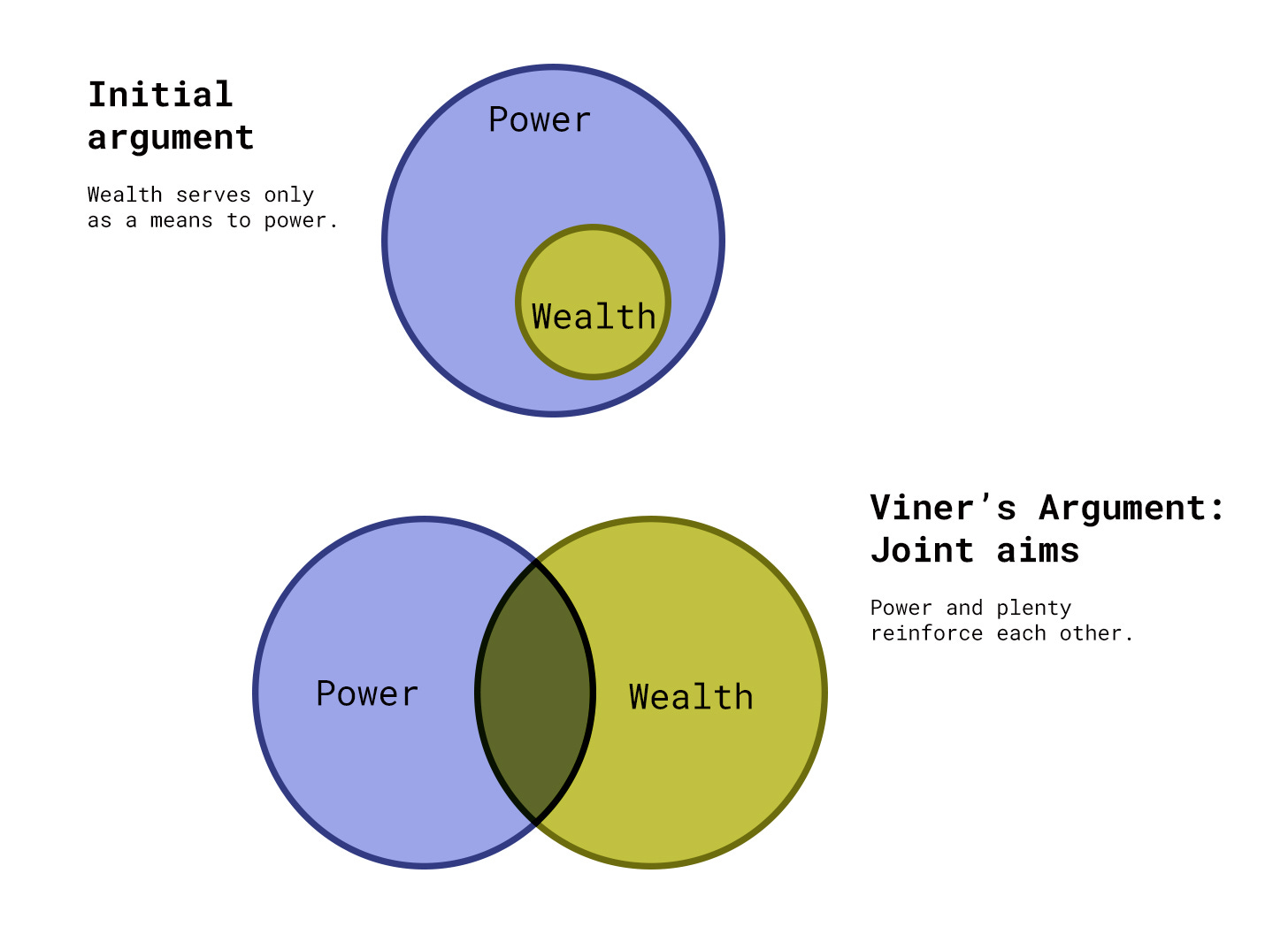
Viner read the mercantilists more closely than earlier interpreters had, but he didn’t dismiss their critiques outright. He agreed that mercantilist writers treated wealth as a means to power, and that they overstate how much strength a full treasury could buy. But he pushed the original interpreter’s argument further. Could anyone actually point to a single mercantilist who called power the sole purpose of policy, or dismissed wealth as worthless apart from the weapons it bought? Heckscher, the historian whose work had established that power-first consensus, knew the sources well, yet he never cited such a line from a mercantilist, and Viner doubted one existed.
Viner’s investigation found that much of the evidence for the power-first reading was thin. Heckscher had leaned heavily on a single line from Colbert, the finance minister of Louis XIV, who wrote that trade is the source of finance, and finance is the sinew of war, the muscle behind every army. Read alone, that line does make commerce sound like a tool of the army. But Colbert also wrote that a good prince puts his subjects’ welfare first, and much mercantilist writing discusses trade and prosperity without ever mentioning war. Viner made a simple point about evidence like this. Silence cuts both ways. If Colbert believed finance was the sinew of war, he would just as easily have said that strength was the sinew of trade.
The mercantilists’ real error, Viner argued, was economic, not political. Many of them treated the world’s wealth as fixed, much like its stock of gold, so one country could only grow richer by making another poorer. Adam Smith mocked this view, in which nations treated a neighbor’s gains as their own losses and grew suspicious of trade that might otherwise have connected them, but a bad theory of wealth is not the same as a preference for power over wealth. Viner’s point was that the mercantilists misunderstood how nations grow rich, not that they cared more about strength than riches.
This is where Viner actually answers the question by rejecting the premise that a side had to be picked in the first place. Power and plenty, he argued, were joint aims that mercantilist statesmen expected to reinforce each other, and the language of the era backs him up. Phrases like “power and plenty,” “wealth and strength,” “profit and power,” and “profit and security” appear again and again in the poems, pamphlets, statutes, and war declarations of the time. Even Adam Smith, mercantilism’s harshest critic, granted that the great aim of a country’s political economy was to enlarge its riches and its power together.
Viner’s account has one important limit worth naming. He never claimed the two aims always lined up. Statesmen sometimes had to spend on defense money they could have put into trade, and they knew it. Most writers of the period thought the sacrifice paid off in the end, since a secure country was best placed to prosper. Smith later coined the harder line that “defense is more important than opulence,” opulence being Smith’s word for prosperity, a ranking the mercantilists themselves never put so bluntly. They would have said instead that defense and prosperity depend on each other, even when the two seem, for a time, to compete.
The false choice Viner rejected has not gone away. Talk of guns versus butter, the modern shorthand for choosing between military spending and domestic prosperity, assumes exactly the ranking of power over wealth that he showed the mercantilists never held. For them, the question barely arose, because a nation needed both wealth and power and pursued them together. Their real problem was economic: a zero-sum view of trade, the belief that one country’s gain always means another’s loss, which set nations against one another instead of connecting them. Viner closed his 1948 essay with a brief aside, noting that this faulty economics had poisoned relations between states, and that the harm had reached into his own time. Three-quarters of a century later, the same faulty economics is back in plainer view: tariffs, export controls, and “de-risking” pacts are all built on the assumption that a country must trade away either its wealth or its security. The mercantilists wanted their nations rich and strong at once. What outlived them, by three centuries and counting, is the belief that a country can only prosper by impoverishing its neighbors, and Viner’s answer- that the choice was never as real as it looked- is worth taking seriously the next time a government insists it has to be made.