



Following the Second World War, the economy has decidedly shifted toward a model of globalization built on the General Agreement on Tariffs and Trade (later the World Trade Organization), the International Monetary Fund, and the World Bank. The United States plays a key role in this economic interdependence, with the U.S. dollar as the world’s dominant reserve currency, thus American firms hold significant economic and political influence. Although it’s common understanding that firms have varying levels of domestic political influence, scholars lack a unified consensus on the exact causal mechanisms, especially in the context of the turbulent economic environment of the 2020s.
In “Supplying Influence: Domestic Production Networks in Trade Politics,” Timm Betz (Washington University in St. Louis) and Leonhard Hummel (Technical University of Munich) propose that globalization may be a double-edged sword. Writing in the Summer 2025 issue of International Organization, they argue that although global supply chains help firms stay competitive, moving production away from domestic suppliers erodes the domestic constituency behind those firms. This results in firms with the largest domestic production networks exhibiting more political influence. Politicians exhibit higher levels of support for domestically integrated firms, which is demonstrated through the approval of their anti-dumping petitions and the number of members of Congress who sign briefs on their behalf.
Betz and Hummel propose a three-part theory to explain this phenomenon. The first part concerns firms’ coalition size and breadth. When a firm can garner support from a greater swath of constituents across different industries, occupations, and constituencies, that translates into more political support. For example, if a tire company can tap into not only their direct employees, but also the employees of the rubber, steel-cord, and chemical suppliers that depend on selling to them, they can have a larger political output. What matters is how large a share of those suppliers’ output the firm buys. The second concerns firms’ economic geography. Firms whose suppliers are spread across many locations thus economically affect a greater number of politicians’ constituents, even when the firm itself is concentrated in one place. Therefore, when they need a petition approved, they can bank on the support of a broader set of representatives because of the vast support network they have accrued. The final part concerns firms’ narrative control. Firms and their allies utilize rhetorical spin to convince commissioners, congresspeople, and constituents to support their desires. Often, this is done by framing protection as restoring fair trade, with benefits shared by domestic firms and workers across industries rather than concentrated in one company.
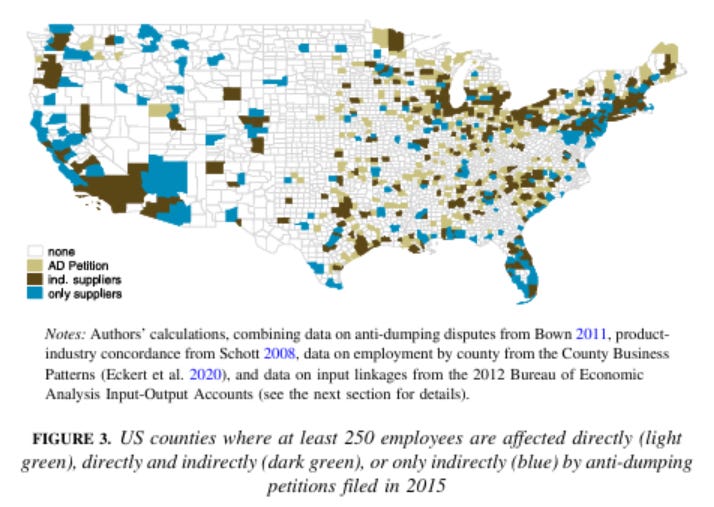
To find the empirical support, the authors collected data from three main sources. First, they collected data on U.S. anti-dumping petitions. They drew this anti-dumping petition data from the Global Anti-Dumping Database from 1992-2019, examining 918 petitions from ~700 petitioners covering about 2,000 products. Dumping is when international firms sell goods below cost and/or the home market price. An anti-dumping petition is filed with the government by firms (and sometimes unions) to request an anti-dumping duty. These duties’ primary goal is to act as short-term relief for domestic firms impacted by dumping. When a firm decides to apply, they file the petition with both the Department of Commerce, which determines whether the goods are being sold below fair value, and the International Trade Commission (ITC), which determines whether the imports harm the U.S. industry; both must rule in the firm’s favor. Anti-dumping petitions act as a good measure of political influence because although the ITC is independent and bipartisan on paper, in reality, the president appoints its commissioners, who require Senate confirmation, and the Secretary of Commerce serves at the president’s pleasure. Congress holds the final say on the ITC’s budget, and if commissioners act in a way lawmakers do not approve of, they can face uncomfortable congressional hearings. When their careers (and budgets) are on the line, commissioners have good reason to act in accordance with those in power.
Second, they drew upon input-output data from the Bureau of Economic Analysis’ Use Tables and Total Requirements Tables from 1997-2017. This account of over 600,000 customer–supplier relationships between industries both records how much each industry buys from every other industry and provides the amount of dollars needed from one industry, including inputs to those inputs, to produce one dollar of output from another, respectively. Last, they integrated firm-level data from Orbis, providing information on firm ownership, multinational status, and stock listing.
With this data, they constructed their test. The authors measured the success rate of the anti-dumping petitions against three versions of their key measure: first, a baseline measure of how much of its direct suppliers’ output a firm’s industry absorbs (Eta); second, a measure that also counts suppliers’ own suppliers throughout the economy (Eta-Total); last, a measure that strips out imported inputs to isolate domestic suppliers (Eta-M). Throughout these tests, they controlled for known predictors of petition success. In the standard model, this controls for industry size, change in imports, steel-product dummy, campaign contributions, non-market economy status, presidential election years, and time trends. In an expanded model, they control for multinational status, stock listing, real exchange rate, fixed assets, and NAICS three-digit industry fixed effects.
The results support their hypothesis. When a firm moved from the 25th percentile to the 75th percentile of the baseline measure, there was a 20 percentage-point increase, from 62 to 82 percent, in the probability that an anti-dumping petition was approved. In addition, they found that when firms shifted more of their inputs abroad, making them less reliant on domestic suppliers, there was a decline in approval rate for anti-dumping petitions. The pattern held when comparing different products from the same firm, and when using exchange-rate swings to trace shifts in sourcing. Petitions tied to larger domestic networks also drew more support in Congress: about twenty more signatures on briefs to the ITC. This means that the larger the share of domestic suppliers’ output a firm absorbs, the more they can draw on the favor of politicians to approve their petition requests. This supports the double-edged sword. Sure, firms can outsource their supply chains internationally, but when they do, they lose the political leverage that comes from a coalition of domestic suppliers.
Betz and Hummel’s research has significant implications given the weight of swing states in American politics. The authors find that 25 to 35 percent of the effect runs through suppliers’ employment in swing states. With rust belt swing states central to the 2016, 2020, and 2024 presidential elections, and going into a politically turbulent and polarized election season in 2026 and 2028, that channel matters. Now, scholars can refer to either their research methods or their theorization of firm political influence to more accurately predict and analyze the way firms’ domestic political influence shapes the political strategies of campaigns and their success/failure. The theoretical and methodological work provides ample resources to draw upon and to spur new investigations into domestic firms in the political sphere.