


Conventional wisdom suggests hawkishness on China is a rare point of bipartisan consensus in today’s hyperpolarized America. In an era of Congressional gridlock, bills such as the Hong Kong Autonomy Act, which sanctioned individuals contributing to China’s diminishment of Hong Kong’s autonomy, receive bipartisan support. Yet not all China-related bills are so uniformly endorsed. For example, the Stop China’s IP Theft Act in 2021 only gained support from Republican lawmakers, and the Taiwan International Solidarity Act was cosponsored by primarily Democratic lawmakers.
An article by Guan Wang (University of Maryland) and Weifang Xu (Emory University) attempts to explain this puzzle. Using an original dataset of China-related congressional bills, the authors demonstrate that bipartisan support for anti-China bills depends on whether or not they address domestic political issues, and whether they relate to issues one or both parties identify as important to their brand. When a measure disproportionately benefits one party, bipartisanship gives way to partisan competition, even when national security is threatened. Their findings complicate the traditional argument that external threats remedy partisan division. In today’s hyperpolarized climate, partisanship may compromise the ability to rally around the flag.
The researchers argue that legislation addressing an issue that directly affects American citizens, such as Chinese investment in the U.S., is less likely to be bipartisan, as political elites strategically leverage domestic policy debates to meet their desired political ends. In contrast, a bill condemning Chinese human rights violations is independent of domestic political competition in the United States, making support for this kind of legislation less contentious and more likely to be bipartisan.They found that when a bill is purely about international affairs, it has a 47% chance of being partisan, which they define as having co-sponsors from only one party. On the other hand, if a bill touches on domestic issues, the chance it is partisan reaches 62%.
In addition, the authors suggest that, among domestically oriented anti-China-bills, legislation regarding issues either party (or both parties) “own” is less likely to receive bipartisan support. If an issue is owned by a party, it is considered to betraditionally important to Republicans or Democrats. For example, voters tend to associate Republicans with issues like national defense and border security, while Democrats are associated with healthcare and environmental protection. When legislation targets China, but includes issues that one party “owns,” lawmakers treat it as a bargaining chip. For instance, a bill that advocates for China to enhance its environmental protection initiatives falls into the category of a Democratic bill because it focuses on an issue many Republican lawmakers may not support and is therefore likely to be partisan.
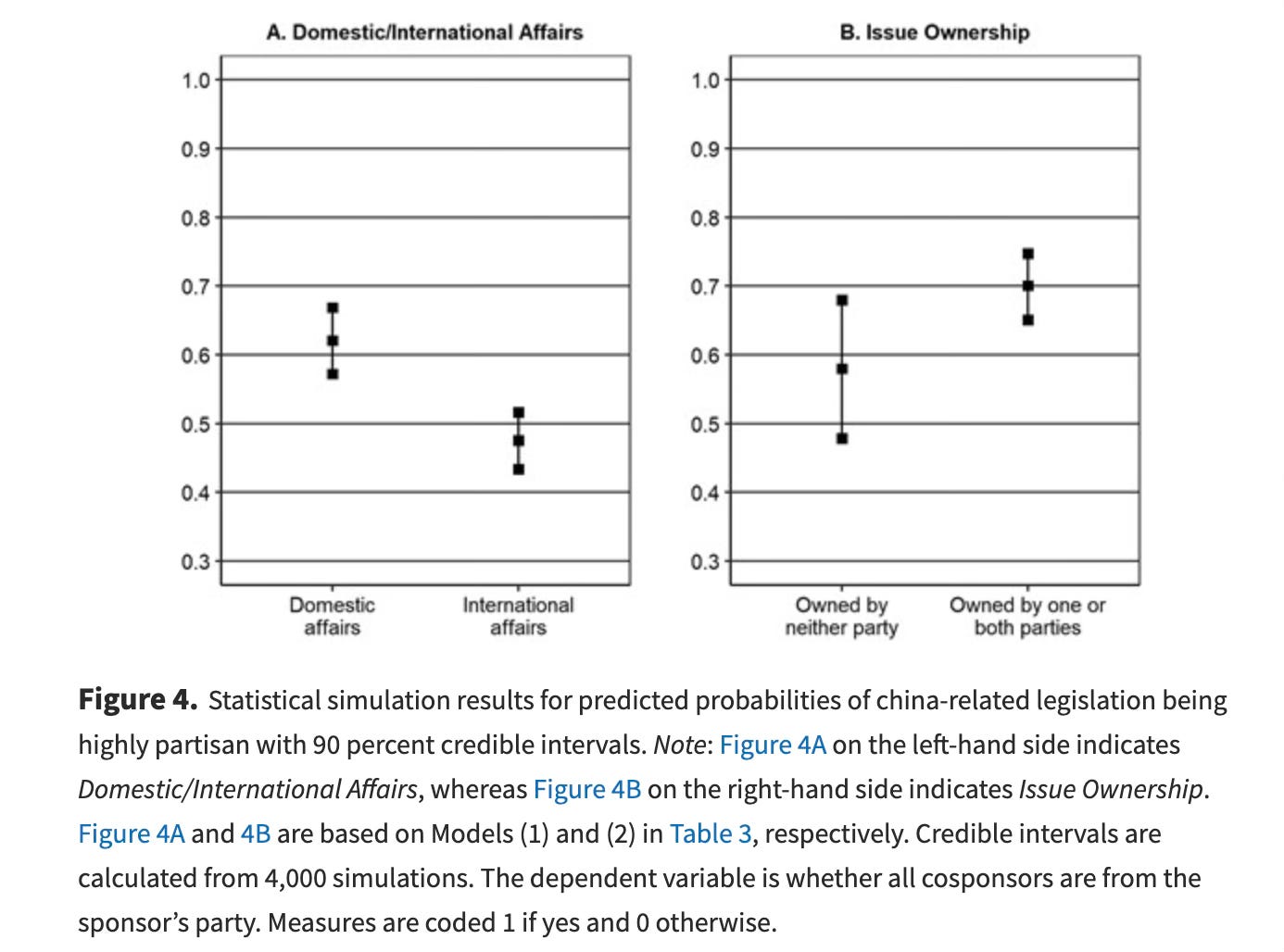
Partisan ownership over domestic issues only covers conventional partisan issues, so the authors explore the impact of nonpartisan issues on China bills. They find that with domestic China bills which neither party owns, like science and technology, the chance it will receive only Republican or only Democratic co-sponsors is approximately 58%.
Bipartisanship falters when there is potential for political ‘wins’ and ‘losses.’ Domestic issues tend to spur political competition. When bills are about divisive issues, like the economy or healthcare, the probability they will be partisan is high, sitting at around 70%. Wang and Xu show that, contrary to what common narratives suggest, China-related bills do not always generate a bipartisan approach. This complicates the theory that foreign threats will necessarily create a unified government, rather, policymakers may prioritize electoral competitiveness over coordinated action.
