


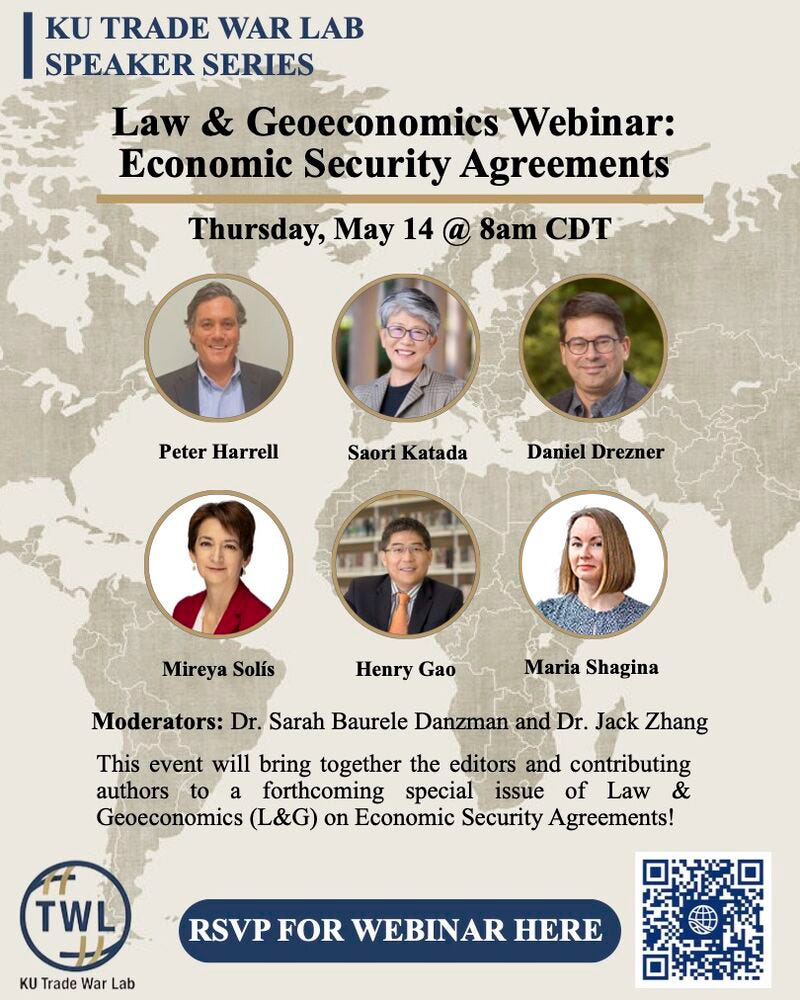
Law & Geoeconomics (L&G) and the Trade War Lab are bringing together contributors to a forthcoming special issue on economic security agreements.
Thursday, May 14, 2026 @8:00-9:00am CDT (Zoom)
RSVP: https://forms.gle/2md4PFrGiHmdr6VN9
These arrangements have proliferated rapidly in recent years—spanning supply chains, critical technologies, export controls, and investment screening. Yet they resist easy categorization. They often resemble trade agreements in form but operate as security instruments in practice. Understanding them requires crossing disciplinary boundaries, which is exactly what this discussion aims to do.
This webinar brings together a set of perspectives from leading experts who will help map the emerging landscape of economic security cooperation and what this means for the future of global trade governance. Taken together, the discussion will highlight both the promise and the tension at the heart of economic security cooperation: the desire for deeper coordination in an era of geopolitical competition contributing to greater uncertainty about how far existing institutions can accommodate this shift.
The essays in this special issue also reflects the broader mission of Law & Geoeconomics: to serve as a platform for rigorous, double-blind peer-reviewed scholarship at the intersection of law and power politics in the global economy. We hope you’ll join us for what should be a wide-ranging and timely conversation.
Moderators:
Sarah Bauerle Danzman (Co-Editor-In-Chief Law & Geoeconomics and Associate Professor of International Studies, Indiana University, Bloomington)
Jack Zhang (Director of the Trade War Lab and Associate Professor of Political Science, University of Kansas)
Panelists:
Author: Daniel Drezner (Academic Dean and Distinguished Professor of International Politics at The Fletcher School at Tufts University)
Title: The Oxymoron of Economic Security Regimes
Abstract: As the open liberal economic order suffers from senescence, there has been a surge in economic security agreements—which now exceed 300 worldwide—as governments increasingly prioritize national security through policies like supply chain resilience, export controls, and critical mineral stockpiling. The paper considers the international relations theory underlying this shift – and the theoretical reasons for skepticism. While economic security is becoming a central organizing principle for international economic policy, its implementation faces significant obstacles. These include vague legal underpinnings, the risk of an economic security dilemma, and the lack of credible commitment from leading economies. Consequently, the long-term sustainability of economic security regimes remains highly uncertain.
Author(s): Mireya Solis (Philip Knight Chair in Japan Studies at the Brookings Institution) and Saori Katada (Louis G. Lancaster Chair of International Relations at the University of California, Santa Barbara)
Title: New Terms of U.S.-Japan Economic Security Cooperation: A Trump Reset?
Abstract: This commentary discusses how economic security has become a central issue-area in U.S.-Japan relations. The bilateral cooperation between these two large and technologically advanced economies constitutes a vital component of collective resilience. Facing the shifting geopolitical ground under the second Trump administration, Japan is actively retooling its economic security strategies, finding both areas to deepen its relationship with the United States and at the same time grappling with a less reliable partner. On the one hand, Japan’s build-up of strategic indispensability could help address U.S. needs and enhance Japan’s leverage. On the other hand, due to the Trump administration’s unilateral actions, the Japanese government faces greater challenges in building collective resilience amongst the “like- minded.” Japan has to aim for economic security in an ever more anarchic world, where the great powers are not willing to pitch in to provide (and abide by) a global economic order.
Author: Peter Harrell (Nonresident fellow at the Carnegie Endowment for International Peace American Statecraft Program)
Title: The Economic Security Elements Of America’s New Trade Deals: Economic Security With Hegemonic Characteristics
Abstract: In 2025, the United States began incorporating economic security provisions into the so-called trade agreements that President Trump signed with nearly 20 countries. These provisions cover both offensive tools, such as investments to boost U.S. and allied supply of critical materials, and defense provisions, such as export control cooperation and cooperation on tariffs. The deals are still in their early days and have yet to be implemented. This article provides an early assessment of the economic security provisions of the deals and makes policy recommendations as they move towards implementation.
Author: Maria Shagina (Diamond-Brown Senior Fellow for at the International Institute for Strategic Studies (IISS) Geoeconomics and Strategy Programme)
Title: Export Controls in US-led Trade Agreements
Abstract: Economic security trade agreements are emerging as the United States’ newest instrument for extending export-control enforcement beyond US borders. Rather than relying solely on domestic rules, extraterritorial licensing, and ex post interdiction, the second Trump administration is embedding anti-diversion and enforcement obligations directly into bilateral trade deals—explicitly linking tariff treatment and market access to partner action on export controls, customs enforcement, transaction screening, data sharing, end-use checks, and cooperation on investigations. In agreements, third countries are not merely encouraged to align; they are operationally folded into a US- anchored enforcement perimeter, turning trade partners into auxiliary nodes in the export-control ecosystem. That is what makes these agreements qualitatively distinctive: they are not traditional trade liberalisation instruments, nor are they standard export-control cooperation statements—they are trade contracts that condition preferential tariff treatment on measurable enforcement behaviour.
Author: Henry Gao (CIGI Senior Fellow and Law Professor at Singapore Management University)
Title: Decoding Trump’s Economic Security Agreements: It’s All About China
Abstract: This commentary examines the emergence of a new category of US trade agreements, beginning with the US–UK Economic Prosperity Deal and extending to recent arrangements with Southeast Asian and Latin American partners. Although these agreements fall short of traditional free trade agreements and are often dismissed as shallow because they do not liberalize substantially all trade, this paper argues that such assessments miss their strategic significance. Precisely because they depart from the FTA model, these agreements illuminate the evolving priorities of US trade policy: the elevation of economic security over liberalization, alignment over reciprocity, and control over efficiency. The commentary analyzes the structure and function of these arrangements, showing how they are designed to address the “China shock” indirectly through third countries, and assesses their implications for China, US partners, and the future trajectory of the global trading system.
Law & Geoeconomics (L&G) is a new double-blind peer-reviewed journal that aims to be at the forefront of the emerging interdisciplinary field of geoeconomics. The journal provides a platform for scholars to rigorously analyze:
1) The role of economic power politics in shaping the laws and norms that govern the global economy
2) The role of law in conditioning power politics by economic means
This is an excellent outlet for scholars working on topics such as economic statecraft, weaponized interdependence, economic diplomacy, economic security, economic warfare, or geoeconomics broadly, and we warmly invite you to join us for this event!
