



The trade war between the U.S. and China has had lasting effects on both nations domestic and international markets, prices, and companies. While much scholarly attention has been paid to the effects of these tariffs on both nations, international trade is no longer a two-player game. Nations maintain complex webs of trade with hundreds of different nations over thousands of different goods. Thus, a U.S. tariff on China does not solely affect China, but every third country that fits within China and the U.S.’s relevant supply chains – whether that’s Vietnam, Germany, India, Brazil, etc. These indirect effects of the U.S.-China trade war have a bounce-back effect since 2/3rds of international trade is conducted by multinational corporations (MNCs) that often have operations within both the U.S. and China. With the complexities of the indirect effects of the trade war, scholarly work was bound to fill that informational gap.
A group of researchers – Harald Fadinger (University of Vienna), Lei Li (University of Göttingen), Sophia Praetorius (University of Geneva), and Jan Schymik (University of Mannheim) – seeks to figure out how the U.S.-China trade war benefited/harmed third countries and reshaped global economic activity and in turn the geography of supply chains. As a measurement of third countries’ economic effects, the researchers track the change in sales, employment and exports for firms throughout the trade war (2018-2022), specifically focusing on the differing effects of input tariffs (taxes foreign intermediate goods, like raw materials) and output tariffs (taxes on domestic exporters). Since much of international trade – about 2/3rds – is operated by Multinational Corporations (MNCs) having affiliates in third countries, the researches accounted for companies’ affiliate status and compared MNC affiliates to domestic firms results. They ultimately found that Multinational Corporations’ (MNCs) affiliate firms were more impacted by tariffs than domestic firms. They also found that while on-net the effects of tariffs were nearly balanced, the specificities of sender/receiver and output/input provided nuance as to when third countries were benefited/hurt.
To collect their data, the researches took plant-level data using Dun & Bradstreet’s WorldBase database of the top 50 largest countries of 200 based on 2018 GPD (excluding U.S. and China for third country data) to track a firms sales, employment, and connections to an MNC headquarters over the course of the Trade War (2018-2022). With hand-collected data on U.S. and Chinese tariffs, the researchers calculate the impact of tariffs weighted by the necessary inputs for an industries production. Using the data set and formula, the researchers track a few key variables. First, they use the Worldbase’s database to test how the change in tariffs from 2018-2022 affected third countries’ firms sales, employment, and number of firms compared to MNC affiliates. Second, they use product-level trade data from the UN Comtrade to track third country exports over the same span of time, isolating exports specifically to U.S. and China. Finally, they used the WorldBase dataset to track firms affiliate status with an MNC along with their sales, employment, and headquarters location (North America, Europe, Asia, etc.). With these measures in hand, the authors ask which tariffs helped third countries, and which ones hurt them.
While there are nuances that enable us to parse when and where tariffs hurt and help, across the data it was fairly consistent that from 2018-2022 multinational corporations responded more significally to tariffs than domestic firms. Their sales were the only significant figures, increasing for U.S. output tariffs on China and Chinese input tariffs on the U.S., and decreasing for Chinese output tariffs on the U.S. and U.S. input tariffs on China. While there are differences in what tariffs increased/decreased sales, the overall effect of tariffs on the 50 largest countries (in terms of 2018 GDP) over the trade war was slightly negative, though was statistically essentially zero. Despite this, the data still displays interesting fluctuations worth theoretical consideration as the trend of protectionism has, as we now know, become a growing economic strategy. To understand the differing effects of tariffs on third countries, the researchers explain that some third countries create more substitution goods – a good that can be supplemented – while others create more complementary goods – goods that must be bought alongside another one and thus have linked demands/prices.
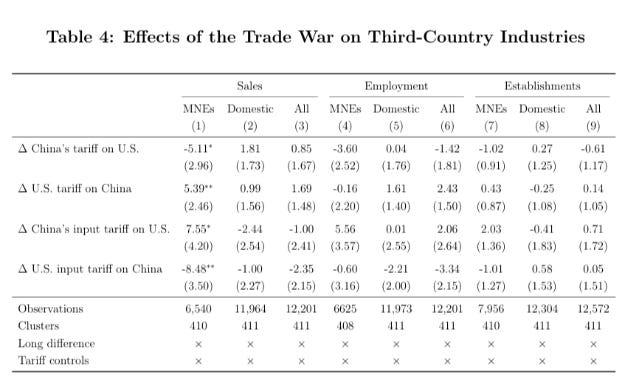
For example, the researchers findings that multinationals reduced their sale in third countries when there were Chinese output tariffs on the U.S. and when there were U.S. input tariffs on China is consistent with their theory that the U.S. creates complementary goods to the third countries in the dataset since both of these tariffs raise prices for U.S. companies: the former through raising prices to offset the Chinese tax and the latter by raising domestic production costs. The inverse follows, showing multinationals increased their sale in third countries when there were U.S. output tariffs on China and when there were Chinese input tariffs on the U.S. This supports that China creates substitution goods to the third countries in the dataset since both of these tariffs’ influence market redirections away from China, displaying their competitive nature: the former by China switching from selling to the U.S. to third countries and the latter by raising production cost within China, causing third country fill-in. The tariffs effect on employment and number of firms was not significant but followed the same pattern.
Those trends mostly describe the behavior of MNCs and their affiliates. The researchers turn to third-country exports to explain the shifts they take across the different kind of tariffs. This omits the U.S. and China, and tracks whether third country exports would increase or decrease to the U.S. and China. Chinese output tariffs on the U.S. significantly decreased third country exports to China, while Chinese input tariffs on the U.S. significantly increased third country exports to China. The former is explained again by third countries making complementary goods to the U.S., since as the tariff forces a U.S. shift away from expensive Chinese goods, the third countries follow. The latter is explained by Chinese substitutional goods being supplemented by third countries as prices increase.
Looking at U.S. tariffs, third country exports to the U.S. increased when there were U.S. output tariffs on China and decreased to the U.S. (and to all) when there were U.S. input tariffs on China. The former is explained by higher prices on substitutional Chinese goods causing U.S. companies to prefer cheaper third countries goods, and the latter is explained by higher production costs in the U.S. cause third country complementary products to follow the loss in prices/demand. All of these findings pair closely with the behavior of MNCs, though the specificities of where trade flows are integral to understanding the behavior of third countries.
International trade is complicated. Multiple different actors and products flowing in countless different directions makes getting a grasp on its functions and patterns incredibly difficult. Despite complexities, a few key findings give more shape to the amorphousness of trade. Most importantly, the trade war’s effects on third countries largely canceled out, leaving a net effect that was slightly negative and not statistically significant. This flat number hides much of the movement happening underneath. The on-net neutral effect is consistent with the fact that tariffs on products and tariffs on inputs pushed in opposite directions due to the U.S. creating complementary goods to third countries, while China made substitutional goods. The researchers found that multinationals were more affected by tariffs than third countries domestic firms, proving that most of the shifts in supply chains were done by MNCs. This gives policymakers and researchers an easier frame of reference to understand trade as primarily conducted by MNCs, and the effects of tariffs at a globally reactive scale. The old framework of a U.S.-China two-player tariff battle is inaccurate in an increasingly interconnected world. Rather than a two-player game, trade should be viewed as a multiplayer free-for-all, with third countries and MNCs trying to find the best position in global supply chains in accordance with U.S.-Chinese tariffs. U.S.-Chinese tariffs.