



Do corporations care about the reputations of countries they conduct business with? When Russia invaded Ukraine, Russia faced widespread condemnation from citizens and the media, followed by economic sanctions from numerous foreign governments. Despite the economic and social pressure, some foreign-invested firms (businesses with at least 10% foreign ownership) remained in Russia, including PepsiCo and Nestle. Why did some firms stay and others leave? Furthermore, are nations able to weaponize and use their multinational corporations as tools to economically pressure other countries?
These inquiries are addressed in the recent paper, Exiting Russia, by Rachel Wellhausen (University of Texas at Austin) and Boliang Zhu (Pennsylvania State University). Examining the variables influencing a firm’s decision to stay or leave, they found that foreign-invested firms in consumer-oriented industries and those under Russian managerial control faced more pressure to exit, while firms in industries critical to Russia’s economy were less likely to leave. To explain this, they argue that Foreign Direct Investment (FDI) exit should be seen as a transaction: firms weigh what’s at stake (reputation, customers, punishment) if they don’t sell against what they give up if they do (selling at a loss, sunk costs, a foreign market).
FDI matters because in an integrated global economy, capital doesn’t just vanish quietly, its sudden removal can disrupt whole economies. While there’s a wealth of literature on why firms enter foreign markets, almost none exists on why they leave, and what little does treats exit as expropriation: the host state seizing or forcing a sale. Wellhausen and Zhu argue that framework doesn’t fit Russia. Rather than expropriating firms outright, Russia mostly let capital leave through voluntary sales, shaped by pressures like consumer opinion, home-state politics, and worsening economic conditions, and by firm traits like hard-to-move assets, industry importance to Russia, and how much domestic managers already controlled.
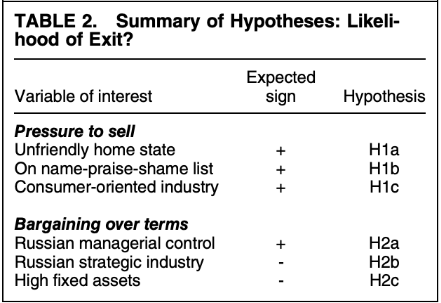
As seen in Table 2, the authors split their variables into two buckets: pressures to sell and terms of the sale. They expected firms to be more likely to exit if they were from “unfriendly” states (H1a), named on public praise-and-shame lists (H1b), in consumer-oriented industries (H1c), or majority-owned by Russian shareholders (H2a), and less likely to exit if they were in industries critical to Russia’s economy (H2b) or industries with more fixed assets (H2c). To test this, Wellhausen and Zhu built a list of 42,720 foreign-invested firms active just before the invasion, then checked 18 months later whether their foreign investors still held meaningful control. Each hypothesis got its own measure: Russia’s own “unfriendly” list for H1a; matches against name-and-shame lists for H1b (16.3% of firms); U.S. advertising spending as a stand-in for consumer orientation for H1c; majority Russian ownership as a proxy for managerial control for H2a; a 2008 Russian “systemically important” firms list to flag strategic industries for H2b; and U.S. industry data on fixed-asset intensity for H2c. They also controlled for factors like whether a firm’s home state was Cyprus, had an investment treaty with Russia, or was state-owned.
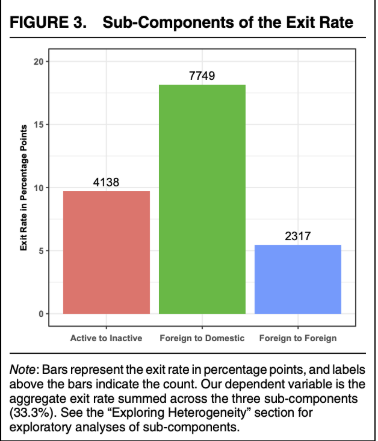
Wellhausen and Zhu’s hypotheses produced mixed results, but almost every variable had a significant effect on firm behavior, whether or not it matched their prediction. Over the 18-month period, the exit rate for the 42,000 firms studied hit 33.3%, up from a pre-invasion rate of 25.3%, though most of that exodus wasn’t firms shutting down: just 5.4% went inactive, while 27.9% stayed active under new ownership. To make sure this spike was actually tied to the invasion and not some other trend, the authors ran a placebo test against Russia’s 2014 annexation of Crimea. H1a (unfriendly home state) and H1b (name-and-shame) were both proven wrong, with firms actually 0.5-3.3% and 4.7-5.6% less likely to exit, respectively. H1c (consumer-oriented industry) and H2a (Russian managerial control) held up, with firms 3.8-4.8% and 5.9-6.2% more likely to exit, respectively. H2b (Russian strategic industry) held up too, but in the other direction: firms in strategic industries were 4.1-4.3% less likely to exit, exactly as predicted. H2c (high fixed assets) had essentially no effect, raising real questions about how much weight asset mobility actually carries in firms’ decision-making.
Wellhausen and Zhu’s article pushes back on the FDI literature to argue that exit should be viewed differently: as a transaction weighing a seller’s pros and cons against how much a firm’s departure would cost the host state, and thus how hard that state will fight to keep it. Their mixed results suggest that while nations can try to prevent firms from leaving through means short of expropriation, like making exit costly for firms critical to their economy, they ultimately cannot reliably weaponize their firms against other countries the way they might wish. A firm’s home nation pressuring it to leave simply isn’t the most important factor in that firm’s decision. But if home states keep pushing firms to become more footloose and quicker to exit, will that undermine other host states’ confidence in FDI as a reliable development tool? That question needs more work to answer, but for now, Wellhausen and Zhu contend that “FDI is at best an imperfect tool of economic statecraft.”