


Since 2016, it seems as though countering China’s rise to prominence has become a rare point of bipartisan consensus among policy makers in the United States. This, however, has not always been the case. Data collected by the Trade War Lab reflects an interesting shift in Washington’s perception of the PRC. To track this shift, researchers at the lab established the “China-related Bills” dataset, which includes all legislation that meaningfully concerns the Chinese government, citizens, and businesses in the United States. Using Congress.gov, the lab collected legislation dating back to the 101st session of Congress, which began in 1989, through the 118th Congressional session.
Looking back to the decades before President Trump’s first term, much of the legislation produced on China, was trade centric, save for a response to the Tiananmen Square crackdown in 1989 via the Chinese Student Protection Act of 1992. The act protected Chinese Nationals studying in the United States by broadening permanent resident guidelines and establishing quicker paths to citizenship. Other bills like H.R.4444, passed in 2000 and signed by President Bill Clinton, authorized the President to extend nondiscriminatory trade treatment to the PRC and paved the way for China’s accession to the WTO. Congress also attempted to mitigate the security risks that Beijing posed to Taiwan. In 1999, Congress passed H.R.1838, or the Taiwan Security Enhancement Act, which aimed to strengthen the bonds between Taiwan and the U.S. by admitting Taiwanese military officers to U.S. academy schools like West Point. The legislation also directed the Secretary of Defense to report to relevant congressional committees on the readiness of U.S. forces and their ability to respond to threats in the Sino-Pacific region. The bill passed the house, but never made it out of the Senate, showcasing Congress’s comparative lack of interest in security concerns involving China relative to today.
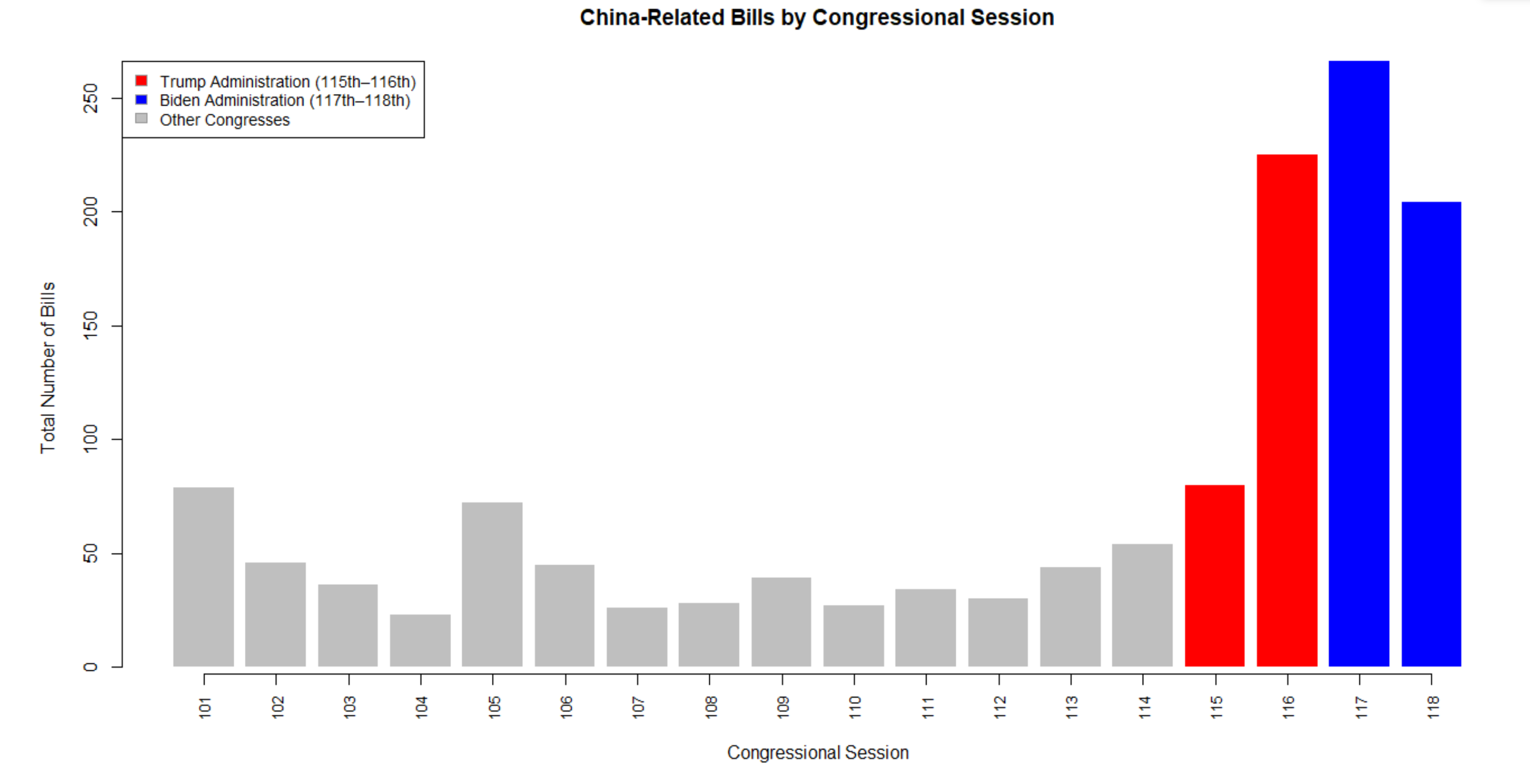
As seen in the graph above, the data collected paints an interesting picture, one that shows how Congress has elevated China from mere a trade partner to a strategic competitor. From Trump’s first two years to Biden’s first two years in office, the data reflects a remarkable 233% increase in legislation introduced that targets Chinese influence. This increase can likely be credited to President Trump launching a trade war in attempt at a large-scale act of reshoring American industry, and the United States’ increasing efforts at preventing China from gaining a leg up in the development of sensitive technologies.
Major legislation such as The Tax Cuts and Jobs Act and the CHIPS and Science Act embody Congresses attitude towards China, locking the U.S into an era of strategic competition with Beijing. The Tax Cuts and Jobs Act slashed the corporate tax rate from 35% to 21%, and allotted a 100% tax deduction on equipment, materials, and manufacturing facilities used in efforts of economic investment on U.S. soil. Those arguing for the bill suggested that the tax cuts would spur American industry and promote competition with China. Many of these provisions set to expire in 2025 were extended indefinitely under the One Big Beautiful Bill Act.
The CHIPS act provides robust incentives for U.S. based companies to develop and manufacture semiconductors, through $52 billion worth of federal subsidies, along with incentives targeting “advanced Nodes” the most cutting-edge chips that power things like Ai, 5G, and defense platforms. The bill also addresses supply chain security for semiconductor manufacturing, barring companies who receive CHIPS funding from expanding advanced chip manufacturing into China for at least 10 years to counter the risk of technology sharing with the CCP.
The Congressional data collected remains consistent with the ongoing story of U.S.-China relations. Once viewed as an emerging market, Beijing has blossomed into a real competitor in spaces the United States has enjoyed total dominance over for decades. The rush to compete with China has resulted in a rapid, bitter response by lawmakers on Capitol Hill. Altogether, the flood of legislation addressing China’s rise marks a clear shift from cooperation to confrontation.

Wow, the bipartisan consensus since 2016 realy stood out. You totally nailed it.