


Chinese designs on the Pacific are no secret. Ever since assuming power in 2012, Xi Jinping has directed the rapid militarization of various islands and shoals in the South China Sea. These developments are often paired with episodes of intrusion and harassment by Chinese vessels in the waters of its neighbors. Nations like the Philippines, Taiwan, and Japan have found their ships rammed, chased, or stalked by Chinese craft. China is unrelenting in mounting pressure for its claims in the Pacific, with no indication of subsiding.
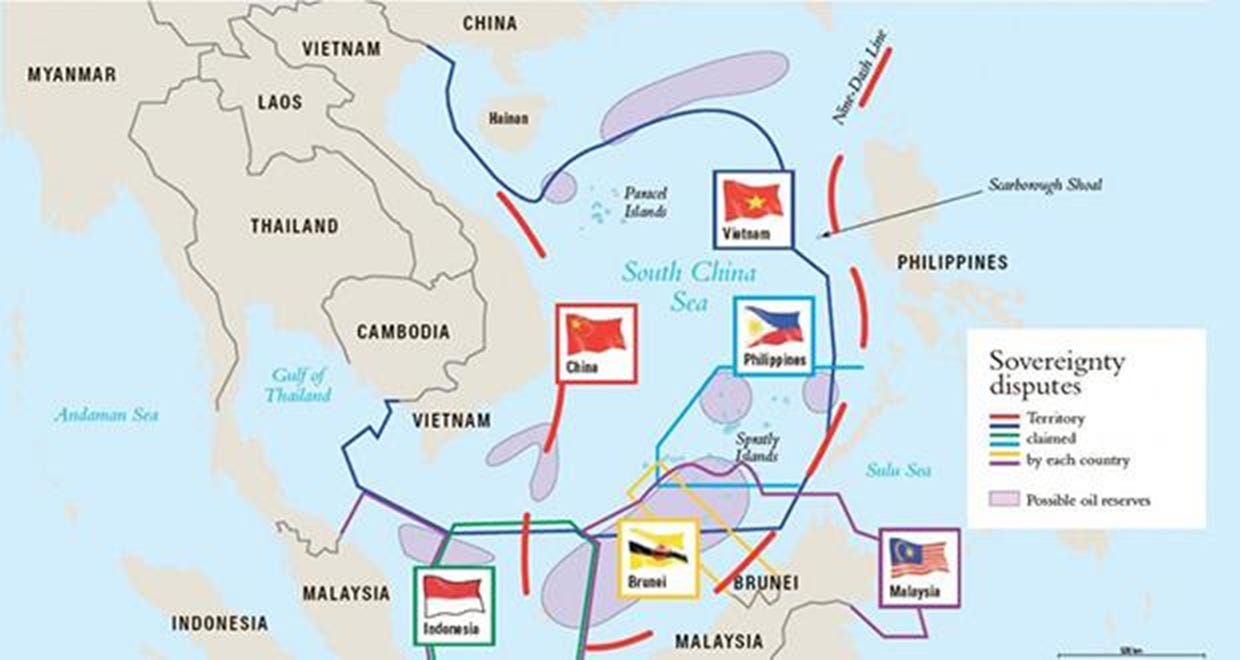
China began asserting its claims to the South China Sea in the late 2000s and early 2010s. In response to exclusive economic zone (EEZ) filings by Malaysia and Vietnam in 2009, China issued notes verbales asserting jurisdiction over the relevant waters to these nations, while also publishing the “Nine-Dash Line.”1 The EEZs of various nations and disputed landmasses lie within this Nine-Dash Line. Key focal points are the Paracel Islands, Spratly Islands, Scarborough Shoal, and Senkaku Islands.2345 China claims all of these areas, though maintains control in just the Paracel and Spratly Islands respectively.
Although sometimes violent, China’s attempts at asserting authority over these disputed territories has stopped short of invasion, instead involving what scholars call militarized interstate disputes (MIDs) and international crisis behavior (ICB). The former term comes from Douglas Gibler’s International Conflicts, 1816-2010: Militarized Interstate Dispute Narratives. In this work, an MID is defined as “a threat, display, or use of force by one state against another state.” For example, a Chinese naval vessel shadowing a Filipino craft within the EEZ of the Philippines would be an MID. An ICB, while similar, is a step above a simple threat or use of force. Rather, it is a specific incident that can be classified as an international crisis or diplomatic incident between two nations. While every Chinese incursion into Filipino waters is an MID, for example, only incursions that lead to some form of diplomatic incident or rupture between the two nations can be classified as an ICB. This term comes from Michael Brecher and Jonathan Wilkenfeld’s A Study of Crisis, which documents ICBs from 1918 to 2019.
Between 2018 to 2025, 7 ICBs have been documented between China and its neighbors. For context, A Study of Crisis documents 3 ICBs concerning China between 2010 to 2017. Of these seven, five consisted of Chinese incursions into the legal waters of its neighbors, often culminating in harassing or ramming foreign vessels. The remaining two consisted of the Chinese-Indian Skirmishes of 2020-2021, and the live-fire drill that the People’s Liberation Army-Navy (PLAN) conducted within the flight lanes of Australian commercial jets. These ICBs mark a clear increase in number compared to those recorded by A Study in Crisis prior to 2018. One possible explanation for this is the “Decision of the Standing Committee of the National People’s Congress on the Exercising of the Marine Right Safeguarding and Law Enforcement Functions and Powers by China Coast Guard.” Promulgated in 2018, this law vested the Chinese Coast Guard the authority to act as law enforcement within the Nine-Dash Line. However, this framework is often weaponized by Chinese authorities to justify their aggressive actions in the South China Sea, thus leading to an increase in incidents. One such example took place in 2020, where a Chinese naval craft rammed and sank a Vietnamese fishing vessel around the contested Paracel Islands. Chinese authorities justified the act by stating the Chinese Coast Guard were enforcing a fishing ban, a power that the aforementioned 2018 law had given them.
It is no surprise then that MIDs are also plentiful post-2018. In a project I undertook as a research assistant for the Trade War Lab, I recorded a comprehensive list of MIDs between 2018 and 2023. I documented over 200 specific cases of territorial incidents between China and another nation. Much like the ICBs, these incidents did not lead to any change in the status quo. Moreover, the vast majority of these MIDs concerned territorial issues in the South China Sea, often consisting of Chinese naval craft and or fishing vessels entering into and then harassing ships in foreign waters. Japan and the Philippines were the maritime neighbors of China with the most MIDs, at 47 and 33 respectively. Additionally, nations like Malaysia, Indonesia, and Vietnam were each involved in multiple incidents with China. Interestingly, many of these MIDs centered around oil survey ships passing through their EEZs, suggesting that China possesses economic interests in enforcing their Nine-Dash Line as much as they do territorial ones.
The dataset also records a number of US encounters with China. The reason for this is that US naval vessels often perform freedom of navigation operations (FONO) in international waters that China claims as part of the Nine-Dash Line. Germany, the UK, and Canada had their own run-ins with Chinese authorities for the same reason. These FONOs were typically protested in statements by China for violating their sovereignty. Lastly, it must be noted that this dataset did not record the often-daily airspace violations performed by the PLA against Taiwan. While these are certainly MIDs, these incidents were outside of the scope of a project that primarily focused on maritime MIDs (with the exception of China’s contested border with Bhutan and India) and frankly were too numerous to be recorded in detail.
Analyzing the MIDs and ICBs indicate two things. Firstly, it highlights the consistent pressure the PRC puts on its neighbors. Whether it be through oil surveys or harassing fishing vessels, there is a concentrated effort to bully and fatigue countries like Japan and the Philippines. Secondly, the increase of ICBs post-2018 indicates an escalation in these efforts. Based on the 2018 Chinese Coast Guard Law, China views the waterways and landmasses within the Nine Dash Line as integral to China, regardless of international conceptions of sovereignty. In a world where the stability of the United States and the post-WWII Global Order it supports are in doubt, it remains to be seen if these gray-zone pressures will increase as they had done after 2018.
