



Industrial hubs have long been understood as sites of economic strength and growth in the United States, but over the last 20 years, these areas have absorbed a disproportionate share of the country’s job losses. Conventional wisdom among scholars holds that economic pain pushes voters left, toward candidates who promise to address those losses. Yet when analyzing voter behavior from the 2000 election of George W. Bush to the 2016 election of Donald Trump, experts observed the opposite: the regions hit hardest shifted sharply to the right. There is ample evidence that Trump tapped into working-class resentment amid globalization, but existing research can’t explain why a similar shock would push one region right and another left.
A recent paper by Sung Eun Kim (Korea University) and Krzysztof Pelc (Oxford University) offer an answer. An industrial hub is a region heavily specialized in one industry relative to the rest of the country, such as Detroit in the automobile industry. The political fallout of a shock, they argue, depends on whether the lost jobs were in one of these concentrated hubs or in a more diffuse industry not tied to any single place. The same shock pushes a hub region to the right and a diffuse-industry region to the left. The difference is identity: in a hub, social and professional networks overlap so completely that the community’s sense of itself is bound up in the local industry, so its decline registers not as a lost paycheck but as a threat to who the region is. Right-wing populists, who speak to nostalgia and lost standing, are best positioned to capture that grievance.
Take Clyde, Ohio, where families have worked at the Whirlpool plant for five generations, and most residents have childhood friends on the line. When the jobs go, the loss strains the whole community, its churches, schools, and sports teams, and strips the town of the industry that defined it. Where pain is scattered across many industries, the left’s redistributive message can address it; in a concentrated hub, it is the right that turns nostalgia and cultural loss into votes.
To test this, the authors identify hubs using commuting zones (counties linked by where people live and work) and cluster mapping, which sorts industries into related groups like automotive and textiles. A region counts as a hub for an industry only when that industry is both unusually concentrated there, and the region’s most distinctive. They measure economic pain with Trade Adjustment Assistance (TAA) petitions from 2000 to 2015; the claims workers file for relief after losing jobs to trade. Because each petition names an industry and a location, the authors split the shock into the part that hits a region’s hubs and the part that hits its non-hubs, which lets them compare equal-sized shocks across the two. They pair this with three original surveys of more than 7,300 Americans, probing peer networks, perceptions of regional standing, and appetite for populist leaders, and, following Autor and colleagues, with the change in each county’s Republican vote share between 2000 and 2016.
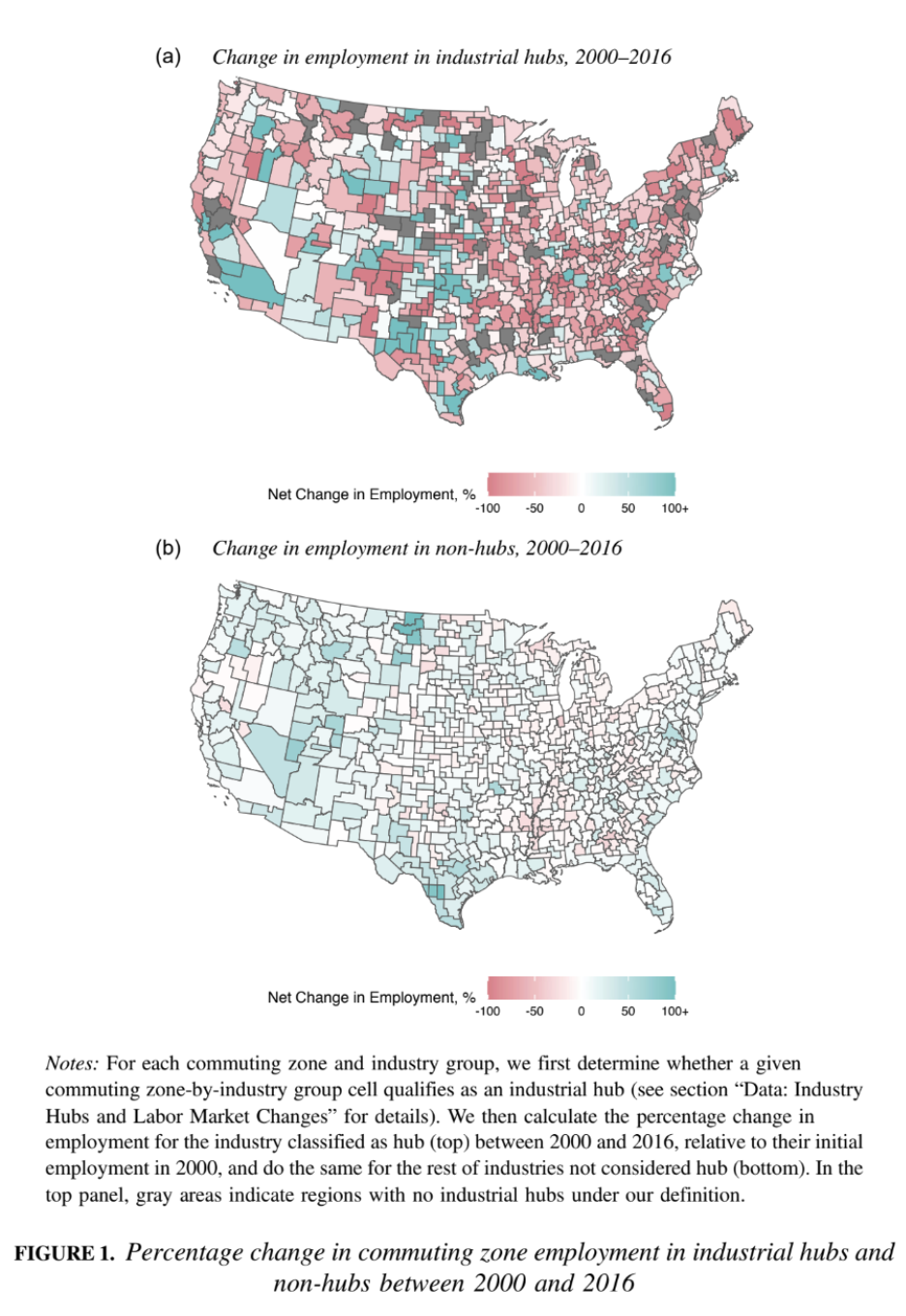
The results line up. Residents of hub regions are far more likely to hold politicians responsible for downturns: on a 0-to-10 scale, 10 more TAA petitions per 1,000 workers in a hub industry raise that belief by 0.12 to 0.13 points, compared with just 0.02 in non-hubs. Peer ties drive this: a one-standard-deviation increase in the number of high-school classmates working in your industry lifts that same score by about 0.55 points, an effect roughly as large as belonging to a union. The same shock erodes people’s sense of their region’s standing more sharply in hubs, a 0.1-point drop versus 0.04, an effect that holds even after accounting for how people rate their own personal status, so the loss is regional, not just personal. And those who feel their region has fallen behind are markedly more drawn to populist leaders, while personal status shows no such pull.
At the ballot box, the pattern completes itself: in a concentrated hub industry, ten more laid-off workers per 1,000 is associated with a 0.38 to 0.49 percentage-point increase in support for Trump in 2016, while the same shock to a diffuse industry pushes voters toward the Democrats.
The throughline is clear: an economic shock’s political fallout depends on whether it hits an industry on which a region is built. In a tightly connected hub, the loss isn’t just to wallets but to the institutions and identity that hold a community together. That is why checks alone fall short. Person-based relief like Social Security and Medicaid steadies individual incomes, but it can’t restore what a community loses when the industry that defined it disappears. Repairing that kind of damage takes place-based support: investment in local industry and infrastructure, not just mailed checks. Economic hubs always have the potential to make an outsized impact on the people who live within them. Whether that impact is job growth spurred by investment or a surge in populist sentiment depends on where the shock lands.