


Original article is Filtering Special Interests: How Institutions Shape the Politics of Trade Securitization.
How do states decide what products are and aren’t important to national security? Democracies across the world are increasingly restricting trade in the name of "economic security." But how do state decide what products are and aren’t important to national security? Almost anything can be framed as a vulnerability because around 40 percent of globally traded products have 90 percent of their exports concentrated in three or fewer economies. Every chokepoint that gets tariffed or has a subsidy to alleviate it creates new winners and losers with consumers paying higher prices. So how do democracies decide what products are and are not important to their national security?
A new dissertation by Timothy Cichanowicz (University of Kansas, now the Japan Foundation Postdoctoral Fellow at Harvard's Weatherhead Center for International Affairs) argues that the answer depends on political institutions. Existing research usually explains trade securitization in terms of high and low politics. The high-politics view says states should restrict products they depend on heavily and can't easily replace. The low-politics view says any redistributive policies will be influenced heavily by domestic interests. Cichanowicz argues that both forces operate at once, and that the context of where these debates play out determines which force is stronger. Presidential systems like the United States have many access points, which let interest groups rebrand sectoral protection as a security imperative and broaden what counts as "economic security." Parliamentary systems like Japan have fewer access points and stronger bureaucratic gatekeepers, which filter out those demands and produce narrower, more technocratic outcomes.
To test this, Cichanowicz compares three cases. The first is the contemporary U.S. Congress. He built an original dataset of every China-related trade securitization bill introduced from 2018 to 2024 and matched the bills to the roughly 6,900 products the U.S. imported from and exported to China at the HS 6-digit level. For each of these products he then measures their dependency on China, its exit cost, and the strength of China-related lobbying in the U.S. Trade Representative. The second case is Japan's Economic Security Promotion Act where he drew on government documents as well as 33 interviews with policymakers, industry representatives, and experts, conducted in Japanese and English during the summer of 2025. The third is how Congress responded to Japan's economic rise by using International Trade Commission reports from 1973 to 1994, trade data, and archival Congressional correspondence from the Dole Institute of Politics.
The U.S. results cut against a pure national security story. Products with both high dependency on China and high exit costs, the textbook chokepoints, were actually less likely to appear in securitizing legislation. Conversely, the products securitized by Japan’s Economic Security Promotion Act were those that had high levels of exit cost. While the U.S. case featured hundreds of products debated by Congress, Japan’s law narrowly designated 12 critical material categories. Six were chokepoints such as fertilizer, antimicrobials, and permanent magnets. Four were chokepoints that Japan sought to protect, such as machine tools and ship parts. Two, semiconductors and storage batteries, fit both descriptions. Interviewees reported that industry proposals for copper, aluminum, and corn starch were rejected. Requests had to survive multiple ministries and committees, and the Ministry of Finance served as an internal veto point. Whereas products like aluminum dominate U.S. discourse, rejection of such requests in Japan was the norm.
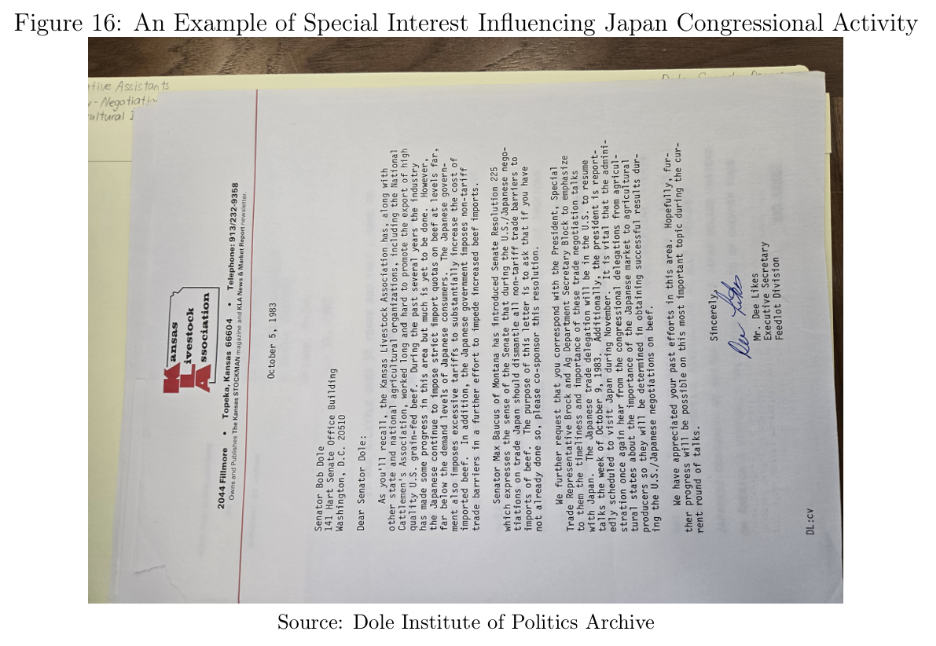
The 1980s U.S.–Japan case tests these dynamics temporally by showing how a perceived rival opens the door for domestic interests. Cichanowicz measures demand for protection against Japan but finds that industry demand for protection against Japan stayed fairly constant from 1973 to 1994. Despite this consistency, Congressional interest in trade protection did not activate until Japan was seen as a threat to American economic dominance. Archival letters show groups like beef producers lobbying to get their products onto the U.S.–Japan trade agenda. Meanwhile, U.S. dependence on Japan for the most-discussed products was already falling before securitization peaked. These findings suggest that for the U.S., economic security threats are an opportunity for special interests to leverage such debates to benefit from market intervention that would not have occurred without the emergence of a status threat.
The implications of this study have key ramifications for consumers and policymakers alike. In power-sharing systems like the United States, technocrats trying to design targeted de-risking policy face an uphill battle because the same system that makes economic security salient also invites opportunistic rent-seeking. Congress matters here too: its bills, even failed ones, often signal priorities the executive later acts on. For ordinary citizens, each product placed behind a “high fence” is one they will pay more for, whether that be through hiked prices or higher taxes.