



In the midst of rising geopolitical tensions, multinational firms are increasingly caught between the government’s interests in national security and protecting their own bottom-line. Recent national security initiatives, like the 2026 Defense Authorization Act, impose restrictions on foreign investment in strategic technological sectors in China. The US is also strengthening its review of foreign direct investment, or FDI, through the Committee on Foreign Investment in the United States (CFIUS). Despite high economic stakes, firms have mounted little visible opposition to policies that appear detrimental to their interests. Why have multinational firms not pushed back against these restrictions on their investment?
Sarah Bauerle Danzman’s (Indiana University) 2025 article suggests securitization may reduce multinational firm’s ability to influence economic regulations. The author’s theory of “securitized political economy” argues this reduced opposition occurs because political securitization carries credibility and reputational risks for firms who choose to lobby, discouraging the act in the first place, and pushing firms toward quieter, more technical forms of influence. These quieter strategies, which often involve lobbying through business associations, are less effective than individual lobbying because they require companies to coordinate in the face of uncertain costs. If current trade politics is truly securitized, the theory implies that firms are unlikely to be able to curb increasingly protectionist trade policy.
Bauerle Danzman’s theory defines a securitized political economy as the process of transforming a policy into a security concern that is widely understood to pose an existential threat. She argues that, when economic policy is framed as a national security matter, firms lose their political influence, or lobbying power, which makes them less able to publicly oppose regulations. The article claims that securitization primarily affects behavior through fear of backlash or a loss of public credibility. Investors and clients of firms opposing national security legislation may believe that they are acting selfishly, unwilling to protect the greater good of the US during a security crisis, and take their business elsewhere. Business’ concerns about public backlash should be more acute in an era where politicians are willing to malign individual firms for political transgressions. The author also references institutional reputational risks. Opposition to security legislation, especially bipartisan initiatives, could alienate congressional allies and, as a result, firms’ influence in the future. Therefore, to avoid these risks, the author suggests that firms rely on backdoor, trade-association, and technical influence strategies that are less public. Although they are more discrete, since securitization can affect firms in dissimilar ways, associational lobbying can present a coordination problem. Some firms are unwilling to invest time and resources into lobbying against policies if the costs to their business are unclear. In sum, fear of lost credibility or backlash should reduce companies’ willingness to attempt policy influence. When they do try to shape policy, they will turn to associational lobbying as a means of mitigating reputational risk. This “quieter” strategy is less effective than direct lobbying because firms with heterogenous interest will struggle to effectively organize.
Danzman utilizes a case study of the US Foreign Investment Risk Review Modernization Act (FIRRMA); a bipartisan law passed in 2018, to articulate her theory. FIRRMA drastically expanded jurisdiction of CFIUS to have broad authority over investment concerns, much like their recent February 2026 initiative mentioned above. The Act allowed the Treasury Committee to review full acquisitions and smaller or indirect investments when national security concerns could be invoked. Her analysis of this process centered around elite interviews, lobbying data, and public comments on rulemaking regarding FIRRMA.
Table 3, ‘Lobbying expenditures by issue and type of lobby group’ in Bauerle Danzman’s Article referenced above. Source: Kim (2018), Industry classification of lobbying entity/client hand-checked for accuracy
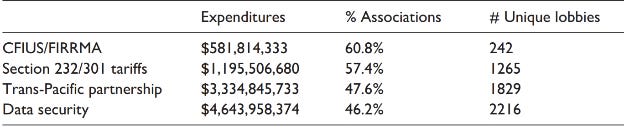
Danzman found that business’s lobbying efforts were limited and largely ineffective. Firms spent about $582 million on FIRRMA-related lobbying from 2017-2022, a modest sum relative to other major economic policies during the same period. She also found FIRRMA lobbying relied more heavily on industry or trade associations, rather than direct firm engagement with institutions. To the extent businesses did attempt to shape the policy, they focused on niche technical adjustments to legislation as opposed to all-out opposition. This pattern reflects the credibility and reputational risks firms face when in opposition to legislation framed as pertinent to national security. This evidence supports the theory that securitization further constrains firm-influence by portraying opposition as contrary to national security, culminating in a chilling effect on firm lobbying. This securitized policy framing, amplified by US politicians’ new-found willingness to single-out individual firms that oppose government policies, often deterred firms from engaging in direct lobbying.
Despite FIRRMAs 2018 appearance on a legislative docket, a trigger-happy President and an increasingly national security focused new cycle illustrate that the idea of securitization prevents firms from effectively opposing policies hurting their bottom lines. By framing economic openness as a national security threat, policymakers constrain not only investment flows but also the political space for opposition. Firms accept narrower, less effective forms of influence at the risk of facing backlash resulting in a shift towards greater state control over economic policy. That brings to light a macroeconomic and governance concern regarding the future of democratic participation and eroding economic opposition to state control.

This article made great points.
Thanks for reviewing my article!