



The United States is a collection of 50 different economies that differ in both what they produce and who they trade with. Much like the European Union, the states within the U.S. are free to trade amongst themselves, though unlike the EU the U.S. can set national tariffs on foreign goods that apply to all states. Differences in industrial specialization, productivity, workforce composition, and access to foreign markets mean that one policy can have sharply different local effects. To attempt to rectify that asymmetrical, The United States’ federal government can redistribute the revenue collected from tariffs across states. This system means balancing tariff revenue with states’ compensation is central to U.S. trade policy.
A recent paper by Ana Maria Santacreu of the Federal Reserve Bank of St. Louis, Michael Sposi of Southern Methodist University, and Jing Zhang of the Federal Reserve Bank of Chicago investigates these differences. In “What Determines State Heterogeneity in Response to U.S. Tariff Changes?” (2026), the authors examine how changes in trade policy affect production, labor income, and consumption across states. Their analysis separates changes in workers’ real incomes from the tariff revenue distributed through the federal government. This distinction helps show whether differences in outcomes stem from states’ industrial strengths or from how tariff revenue is shared. The authors ask why states respond so differently to the same tariff and whether redistributing tariff revenue can offset the losses.
To explain these differences, the authors distinguish between external and internal comparative advantage. External comparative advantage describes industries in which the United States is relatively better, or more cost-effective, at making a good than foreign economies, such as computers and electronics or chemicals; the country is comparatively weaker in industries such as mining and textiles. An internal comparative advantage describes industries in which a state is relatively better, or more cost-effective, at making a good then other U.S. states; Wyoming specializes in mining, while Oregon is relatively strong in computers and electronics. When tariffs make imported goods more expensive, spending shifts toward domestic producers, especially in industries where the United States normally depends more on foreign suppliers. States specializing in those protected industries benefit most. The central finding is that states tend to gain more when their internal strengths lie in industries where the United States is comparatively weak abroad.
To test this explanation, the authors build a model of trade using projected trends based off 2012 [unit of analysis]-level data among 50 states, eight foreign economies, and the rest of the world, covering 16 different industries. The model incorporates differences in productivity, trade costs, labor skills, and the inputs industries purchase from one another. It also estimates trade flows where direct state-level information is unavailable. In the main experiment, the authors increase U.S. import tariffs on goods by 25 percentage points, assume foreign countries do not retaliate, and initially prevent workers from moving between industries or states. Tariff revenue is returned to workers in equal amounts after adjusting for local prices. This setup allows the authors to separate consumption changes arising from workers’ real incomes from those arising from revenue transfers.
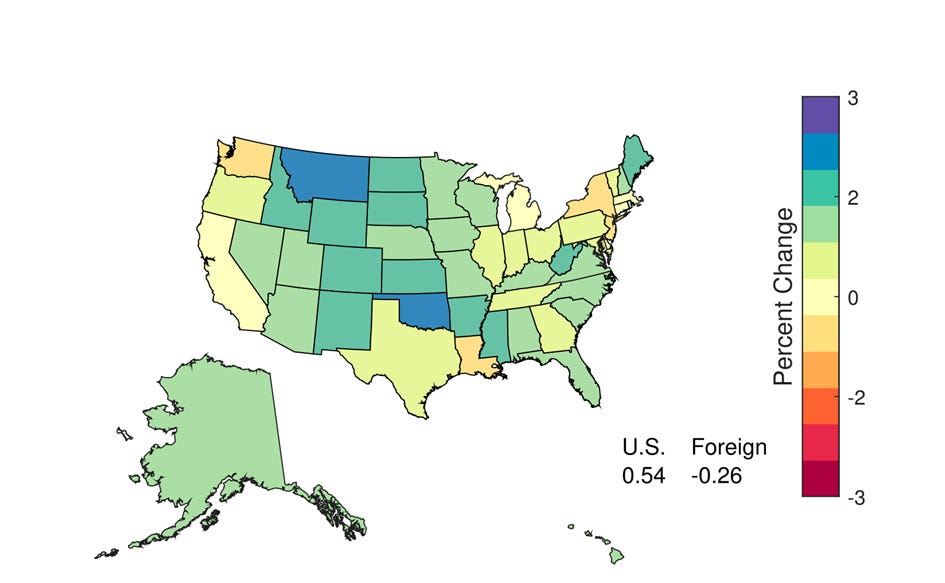
Figure: Map of the percentage change in consumption across U.S. states following a 25-percentage-point tariff increase. Source: Santacreu, Sposi, and Zhang (2026), Figure 7.
Under these assumptions, U.S. consumption rises by 0.54% on average, but state outcomes range from a 0.8% decline in Washington to a 2.3% increase in Montana. Industry matters substantially more than geography, differences between industries account for 79% of the variation in changes in real income across state-industry pairs, compared with 3% for differences between states. Wyoming and Oregon show why. Wyoming’s consumption rises by 1.91%, while Oregon’s rises by only 0.30%. Changes in real income contribute 0.68 percentage points to Wyoming’s result but subtract 1.25 points from Oregon’s. Their tariff-revenue contributions are relatively similar. Wyoming benefits from protection for mining, an industry in which it is competitive domestically, but the United States is comparatively weak internationally.
These gains become smaller when the authors relax the assumption that workers remain in place. If workers can change industries within their state, the national consumption gain falls to 0.23%; if they can also move between states, it turns into a 0.11% loss. Workers respond to tariff-induced wage changes by shifting toward protected industries and locations, which are not necessarily the most productive. Foreign retaliation is even more damaging. When trading partners impose matching 25-percentage-point tariffs on U.S. goods, the initial 0.54% national gain becomes a 0.94% loss under immobile labor. The spread of outcomes across states also doubles, as states more reliant on foreign export markets face larger losses. National gains, then, depend on both workers’ ability to move and other countries’ responses.
These uneven effects also give states different preferences over tariff policy. With immobile labor, the model estimates that a 26-percentage-point increase maximizes national consumption, compared with 19 points for Oregon and 34 for Ohio; Wyoming’s preferred increase has no upper bound in the model. Because the United States is a fiscal union, it could redistribute additional tariff revenue to compensate states that lose, but only when a tariff produces enough aggregate gains to share. The authors’ simulation of the 2018–2019 trade war illustrates the stakes. Without retaliation, 13 states experience consumption losses; with retaliation, 36 do, and national consumption falls by 0.3%. The inference here is that the possibility of compensating those losers depends on whether the country gains at all.