



Economic sanctions are a frequently used alternative to military force, a way for governments to pressure foreign countries by imposing economic costs rather than deploying troops. They are meant to make the targeted country pay a high enough price that it changes its behavior, but they rarely affect only the target. They can also disrupt businesses in the sanctioning country that depend on trade relationships with the sanctioned country. Scholars have long been deliberating whether sanctions actually work, but far less attention has been paid to how these firms respond when their own government’s policies threaten their operations. Do companies back sanctions for the national interest, or do they push back when their profits are at stake? This article looks at US firms that lobbied Congress over sanctions on Russia, and finds that the firms most deeply embedded in Russian supply chains were the ones most likely to lobby against the sanctions.
According to a recent paper by Lingbo Zhao (Pennsylvania State University), corporations’ decisions to lobby against economic sanctions are driven far less by loyalty to U.S. foreign policy than by their own economic ties to Russia. In particular, firms whose exports relied on Russian inputs were especially likely to oppose sanctions. When sanctions threaten to disrupt supply chains, foreign investments, or imports, corporations are far more likely to lobby against the legislation before it even passes. This finding challenges the assumption that domestic corporations will support their government’s foreign policy regardless of cost, highlighting instead the tradeoffs firms weigh between national interest and economic burden, and raises questions about the extent to which private economic interests influence the success of sanctions.
To figure out why corporations opposed sanctions, Zhao built an original dataset of U.S. firms that lobbied on bills proposing economic sanctions against Russia between 2014 and 2022, a period that included three major waves of sanctions tied to Crimea, election interference, and Russia’s invasion of Ukraine.
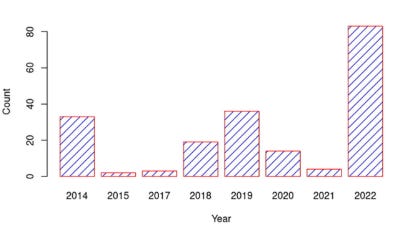
By comparing federal lobbying records with a sample of about 48,000 large U.S. firms, Zhao examined three specific ways a company might have financial ties to Russia: how dependent its industry was on Russian supply chains, whether it had subsidiaries operating in Russia, and whether it purchased goods directly from Russian companies. To avoid using data already affected by earlier sanctions, Zhao used 2013 as a baseline and then conducted additional analyses to estimate the likelihood that a firm would lobby at least once during the period studied.
All three of Zhao’s hypotheses were supported by her findings. Companies in industries that depended on Russian materials or goods to continue operation showed significantly higher rates of lobbying. At the individual company level, having a Russian subsidiary or importing from Russia were both predictors of lobbying activity, with direct imports having a particularly large effect. To ensure the findings were not merely showing that large companies tend to lobby on everything, Zhao conducted a placebo test. The same Russia-related business practices did not predict lobbying on domestic issues such as taxes or labor policy. Ultimately, the results showed that firms responded to specific threats that depended on their operations.
Governments often think of sanctions as a straightforward tool of foreign policy to pressure foreign governments, but Zhao's research demonstrates that they can produce unintended consequences for businesses in the countries that impose them. U.S. firms with substantial investments, trade, or supply chain connections to sanctioned states are more likely to lobby against sanctions that threaten their own operations. Although Zhao does not determine whether this lobbying actually weakened sanctions, her findings suggest that firms could have an influence on how effective sanctions ultimately are. The study provides an excellent illustration for how the globalization of production complicates governments' ability to pursue foreign policy objectives without imposing costs on their own economies.