



Every four years, thousands of companies brace for the same event: a presidential election that could rewrite the rules they operate under overnight. Tax breaks might vanish, tariffs might appear, or existing regulations might flip. Firms can try to influence which candidate wins, but it turns out many of them have found another way to manage it, paying lobbyists.
A recent paper by Kristy Buzard, Nathan Canen, and Sebastian Saiegh (of Syracuse University, the University of Warwick, and UC San Diego) finds that firms that lobby experience significantly less anticipated stock market turbulence around elections than firms that don’t. Rather than relying on news coverage or surveys to measure this, the researchers built a new indicator from the options market, watching how investors themselves priced the uncertainty of individual companies in the days surrounding the 2020 presidential election. What they found is that the market treats lobbying firms as safer bets, and that this pattern holds up even after accounting for standard reasons some firms lobby and others don’t.
To measure firm-level political risk, the researchers resorted to a corner of the stock market that trades entirely on expectations: options. An options price reflects how much investors think a stock could move before the option expires, so by comparing options that expire just after the election to those that expire well after, the researchers could isolate how much volatility they were pricing in specifically due to the election. They ran this exercise for roughly 2,500 publicly traded firms with data pulled from OptionMetrics, then merged it with lobbying outlay records from the LobbyView database to see whether a firm had spent money trying to influence policy in the four quarters before the election (Q3 2019 through Q2 2020).
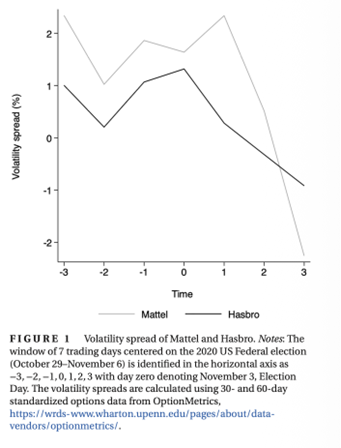
Firms that lobbied had “policy risk” scores 11.5% to 21.9% lower than the average firm in the sample. Policy risk is the researchers’ term for how much post-election turbulence investors expected in a firm’s stock price, estimated by comparing options prices in the days before the vote. Investors expected calmer waters ahead for firms that lobbied than for similar firms that didn’t. That gap held up even after the researchers controlled for size, industry, financial health, and dozens of other political variables like PAC contributions and revolving door hires. So, it wasn’t simply that lobbying firms happened to be bigger or more stable to begin with. The effect also grew with the size of a firm’s lobbying budget. The more money a company spent on lobbying, the calmer investors expected its stock to be. Firms that spent the most on lobbying saw about a 13.77% drop in anticipated post-election swings compared to firms that didn’t lobby at all.
The paper’s more interesting contribution explains why this pattern exists in the first place. Lobbying firms and non-lobbying firms are not identical to begin with. In the sample, lobbying firms tended to be larger, older, more profitable, and already more politically active than firms that skipped lobbying. That raises an obvious question. Maybe these firms simply look calmer to investors because they are bigger and sturdier, not because lobbying itself changes anything. To test this, the authors built a statistical model that accounts for the fact that firms choose to lobby only when they expect it to pay off. Even after doing this, lobbying was still linked to meaningfully lower anticipated volatility. If anything, the effect got larger once this selection process was taken into account.
From there, the paper turns to a bigger question. Why do only some firms bother lobbying at all? Since the 1995 Lobbying Disclosure Act, firms have had to publicly report how much they spend on lobbying. In this dataset, only about 32% of firms did so ahead of the 2020 election. To explain that gap, the authors build a model that treats lobbying like a costly bet. A firm has to pay a fixed cost just to enter the lobbying game, plus a variable cost that rises with how intensely it lobbies. Whether that bet pays off depends on what the authors call a firm’s “lobbying favorability,” essentially how much political access, connections, or existing privilege a firm can draw on. The researchers estimate the fixed cost at around $12,500, which lines up closely with what real Washington lobbying firms charge as a minimum retainer. They also find that the payoff from lobbying shrinks quickly. Each additional dollar spent buys progressively less protection.
This helps explain a longstanding puzzle in political science. Despite how much money appears to be at stake in Washington, most companies still choose not to lobby. The paper’s answer is that the payoff from lobbying is highly skewed. A small set of firms, generally larger ones with more to protect, see returns that clearly justify the cost. Everyone else looks at the price tag and decides to take their chances with the election instead. The authors are careful about the limits of their evidence. Because the study focuses specifically on elections, it does not capture other sources of policy uncertainty, like regulatory risk from federal agencies, that operate through different channels. Still, by tying a firm’s lobbying decision directly to a measurable drop in investor uncertainty, the paper offers a rare, quantifiable window into whether lobbying actually works.
The authors connect their findings to two bigger debates. The first is a longstanding puzzle in political science. If lobbying really buys this much protection, why doesn’t every firm do it? The skewed and quickly diminishing payoffs documented here help answer that. The second is the ongoing debate over restricting lobbying. If lobbying works like insurance against election related risk, then limiting it could leave firms, and by extension their shareholders and employees, more exposed to the swings of American elections, not less protected. For roughly a third of American firms, the ones with the most to protect, the market seems to agree that the insurance premium is worth paying.