


Following World War II, free trade became a foundational pillar in the international economic order. However, beginning in January 2025, the Trump administration has accelerated the more protectionist approach that began in the first Trump administration and continued during Biden’s term. In early 2025, the United States government announced a 25 percent tariff on both Canadian and Mexican goods, coupled with a 10 percent tariff on Chinese goods. Following their first round of tariffs, the White House declared “Liberation Day,” imposing a broad 10 percent tariff on all imports. This abrupt transition has generated a fear that the broader international trade system will collapse in the face of protectionist trade practices.
In their recent publication, authors Andreas Dür (University of Salzburg) and Alessia Invernizzi (ETH Zürich) argue that, contrary to prevailing wisdom, the international trade system is adaptable, resisting harms from shifting trade practices. Historical patterns suggest the United States has always combined free trade and protectionist policies. Consequently, they conclude, a terminal decline in global trade is far from guaranteed.
The authors aim to explain the United States’ trade policy using two core dimensions:
1. The pressure for protection measures versus free trade.
2. The extent of the linkage between trade and national security.
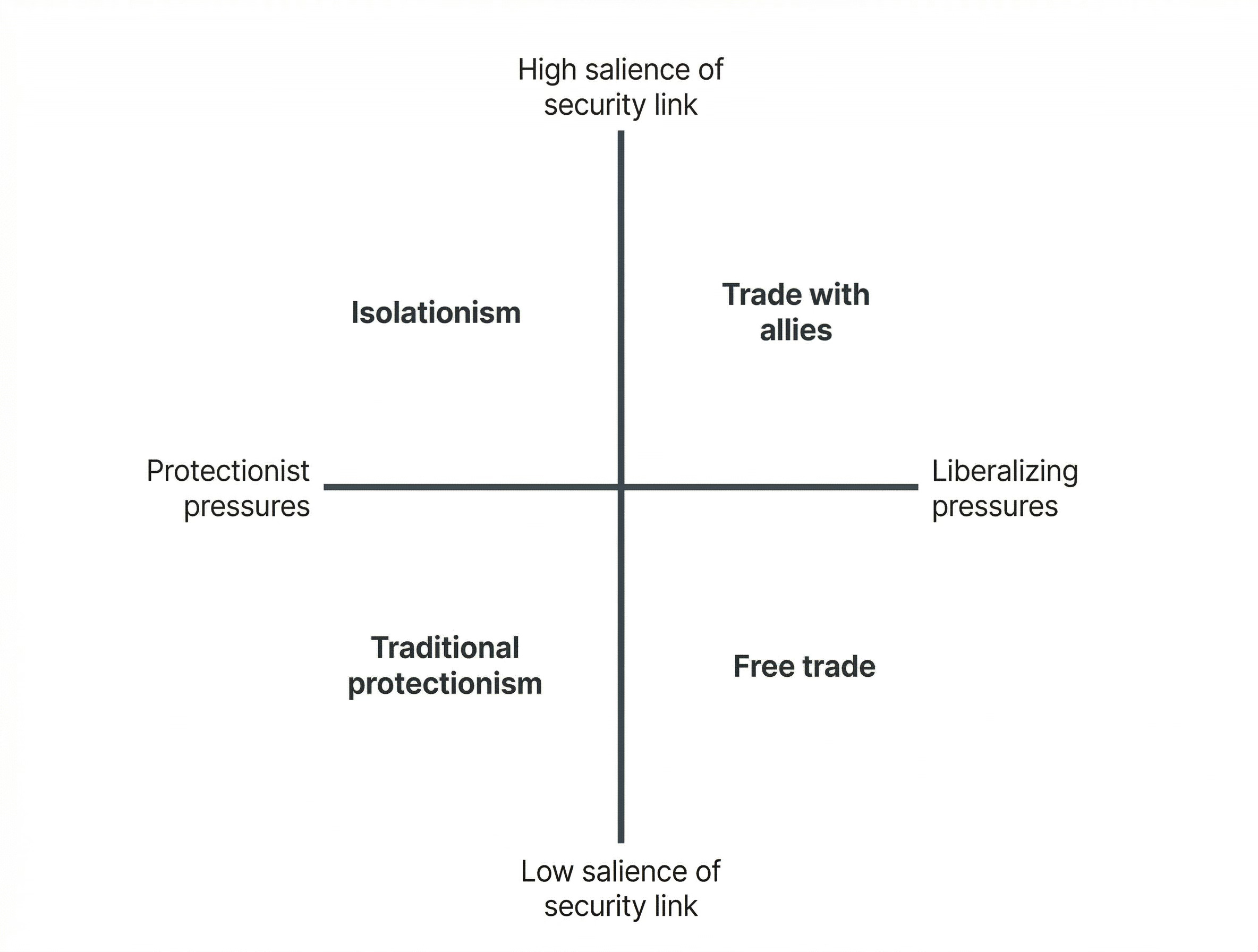
Public opinion, interest groups, and the political preferences of elites combine to push policy towards or away from trade liberalism over time. The authors suggest that when these pressures support free trade, countries tend to completely liberalize trade or trade with allies. When pressures turn protectionist, states will protect key industries or fully isolate themselves from the global economy.
Therefore, according to the author’s theory, liberalizing and protectionist pressures can each produce two distinct policy outcomes; which of the two is realized in each case depends on the trade–security linkage. A high salience of security link indicates a strong connection between national security and trade in the minds of the public and political elites. For example, trade security linkages could appear if a country is over reliant on geopolitical rivals for goods. On the other hand, a low salience on security link indicates there is no inherent view of trade through a geopolitical or security lens, rather, there is an emphasis on economic policy.
The authors suggest that the United States might be in a state of trade isolationism (quadrant 2), as the country is experiencing both protectionist trade pressures and a salient trade-security linkage. However, they also argue that protectionism is currently a far more crucial factor than security concerns, meaning recent US policy sits somewhere in the lower left of Figure 2’s third quadrant.
Based on their theory, the authors argue that there are several reasons to believe this period of restrictive trade policy will pass. First, public opinion is likely to turn against trade restrictions. A March 2026 poll shows that the majority of voters (72%) believe the recent tariffs have resulted in a negative impact. Considering the increasingly large amount of backlash, the isolationist measures have garnered trade protectionism may not remain politically viable for long.
Diminishing corporate support for tariffs may also prevent the US from sustaining near-isolationist policies. Some industries like steel benefit from issue-specific tariffs but are punished by across-the-board policies because it makes their input prices higher. At the point where trade policy no longer serves these specific business interests, support for them is likely to dry up.
The final reason trade policy will likely loosen is that restrictive trade policy creates economic losers, who should mobilize to oppose these policies. Companies that are dependent on foreign intermediate goods suffer from intense tariff policies. Most commonly, these firms respond by lobbying policymakers and supporting campaigns that align with trade liberalization. With increasing resistance, economic losers form organized opposition groups and champion new officials that promote trade liberalization.
Given the expected decrease in public and corporate support for tariffs, and the historical precedent of less-than-liberal trade policy, authors Dür and Invernizzi predict that the United States will eventually walk back most of the current policies. The culmination of decreasing public opinion and sensitive business interests leads them to believe the trade policies will shift back to their eclectic middle ground. The global system has proven resilient in the past, surviving major economic storms before, including COVID, the 2008 global financial crisis, and the protectionist turns of the 1970s and 80s. Further, important players such as the European Union and China continue to adhere to the World Trade Organization’s rules and form their own strategic partnerships to keep trade open. These countries remain dedicated to liberal trade practices, effectively absorbing short-term disruptions in hopes that domestic political pressure in the United States will subside. Despite a sharp turn against free trade, Americans and their allies have reason to hope the US will return to free trade soon.
