



When political tension rises between nations, the effects are rarely contained within the government: they quickly reach the ears of multinational corporations (MNCs). Following President Chen Shui-bian’s 2002 “One Country on Each Side” (OCES) speech, tensions between China and Taiwan escalated quickly. Taiwan’s stock market dropped 5.77% in a single day,1 and Beijing warned the speech was “pushing Taiwan into war.”2 MNCs faced uncertainty over whether the tension would disrupt their supply chains. This article examines how MNCs respond to political tension, and why some firms adjust their trade strategies far more than others.
A recent paper by Fanying Kong (University of International Business and Economics, China), Shengqiao Lin (University of Toronto), and Xuan Wang (Peking University) examines how MNCs adjust trade strategies during political tension. The authors argue that political tension alone, even without any actual military conflict, creates enough uncertainty to push firms into ‘de-risking’: cutting back on suppliers from the tense region so they’re not caught off guard if trade gets disrupted.
To explain why multinational corporations respond differently to political tensions, researchers began with a straightforward theory. Firms adjust their strategies according to the risk they face, and as geopolitical tension rises, companies worry about supply chain disruptions and may reduce trade with risky regions. However, the researchers argue that not every firm assesses that risk the same way, depending on two mechanisms.
The first is supply chain connectedness. Firms that rely heavily on suppliers from a politically risky region, have geographically concentrated supply chains, or use imported goods for further processing face more exposure because they’ve invested more heavily in those relationships. For instance, two firms might each get 70% of their imports from Taiwan, but if one sources the remaining 30% from five different countries while the other relies on a single supplier, the latter has far fewer alternatives if trade is disrupted. Firms that use imports in processing also have higher sunk costs, since their production lines are built around specific suppliers, making adjustment expensive.
The second is home connections. Firms with investment origins in the risky region tend to have stronger relationships, more trust, and better information on local conditions, all of which reduce uncertainty. That makes Taiwan-invested firms less likely to change their trading behavior even as tensions rise.
From this, the researchers proposed three hypotheses. MNCs reduce imports from a host country’s adversarial regions during political tension (H1). That reduction is larger for firms more reliant on suppliers in those regions, more concentrated in their sourcing, or trading final goods rather than processed ones (H2). And MNCs invested in the adversarial region itself are less likely to cut imports, since those ties act as a buffer (H3).
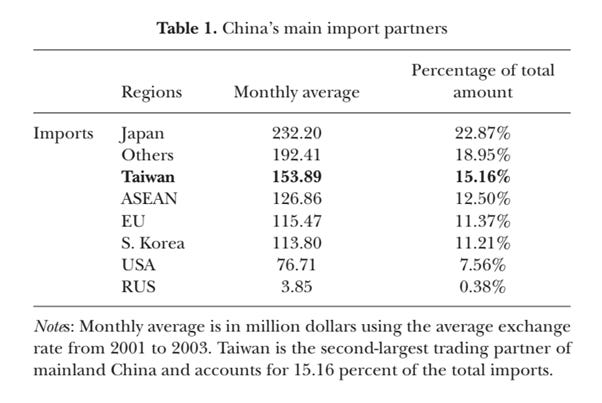
To test these, the researchers analyzed over 1.4 million import transactions from 20,854 foreign-invested firms in mainland China between 2001 and 2003, drawn from multiple government databases and tracking import values, supplier locations, investment origins, and whether goods were used for processing. Using synthetic control and difference-in-differences methods, they compared Taiwan imports before and after the OCES speech against imports from other countries. Taiwan was an ideal test case. As Table 1 shows, it was China’s second-largest import partner at the time, at 15.16% of total imports, right behind Japan.
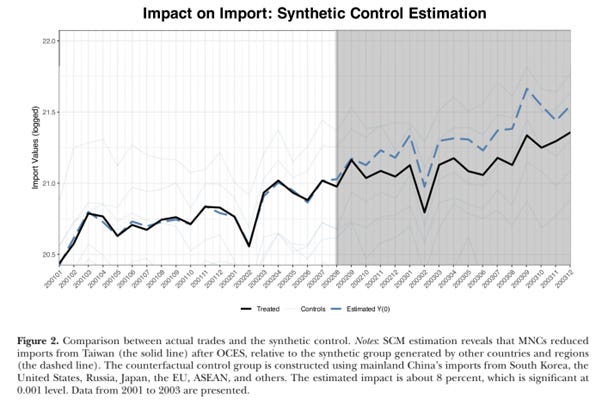
Running these models against the data, the researchers found strong support for their hypotheses. After the OCES speech, MNCs cut imports from Taiwan by roughly 8% relative to the expected trend (Figure 2), and firm-level estimates landed in a similar 7.13%-9.62% range across models. Firms heavily reliant on Taiwanese suppliers saw larger declines, while processing-trade firms cut imports about 9.8% less than firms buying finished goods, confirming the sunk-cost logic behind embeddedness. And home connections mattered: non-Taiwan-invested firms cut imports by about 8.9%, while the effect on Taiwan-invested firms was statistically insignificant, meaning those relationships genuinely buffered firms from the shock.
In a moment of rising geopolitical competition, this study shows MNCs make decisions based on political risk as much as profit. Firms adjust supply chains depending on their exposure to uncertainty and their embeddedness in risky regions, while home connections let some firms ride out tension that hits others harder. That means political conflict can reshape trade long before sanctions or military action ever occur, and it makes firms worth studying as political actors in their own right, not just economic ones.
This pattern keeps appearing. For example, after U.S. House Speaker Nancy Pelosi’s 2022 visit to Taiwan, Taiwan’s exports to China fell 4%, then another 21% in 20233, while many Chinese firms opened operations in Mexico to hedge against exactly this kind of risk.4 As global supply chains grow more entangled with geopolitics, the harder question is what this de-risking looks like over the long run. Are firms permanently restructuring where they source from, or just pausing until tensions cool? The researchers note their data captures trade volumes but not the full architecture of firms’ supply networks, leaving that question for future work.
Sina Finance, "Chen Shuibian's 'One Country on Each Side' Hit Taiwan Financial Market, Taiwan Stock Drop by 500 billion," August 6, 2002.
Xinhua News Agency, "Dangerous Provocation—Commentary on Chen Shui-bian's Divisive Remarks," August 6, 2002.
Statista, "Value of goods exports from Taiwan to mainland China between 2013 and 2023," March 1, 2024.
The Economist, "Why Chinese companies are flocking to Mexico," November 23, 2023.