



In recent years industrial policies, meaning tariffs and subsidies that governments use to shape economic development, have emerged as the predominant tool for major economic powers. For example, China announced a 500-billion-yuan subsidy for their semiconductor industry in late 2025. The United States’ analogue to Chinese chip manufacturing promotion, the Chips and Science Act, likewise uses subsidies to incentivize semiconductor production. These policy initiatives are indicative ofa broader shift from free market to interventionist economic policies. Industrial policy now serves as the backbone of national security strategies, rather than a bulwark of development policies.
A paper by University of Cambridge researchers Jostein Hauge, Bruno Houtzager, and Alessandro Julian Hörmann describes the recent national policy approach as neomercantilism, or the belief that national security depends on independent domestic production, especially in critical sectors such as semiconductors.1 This theory posits that governments should use economic tools such as tariffs, subsidies, or quotas to compete on the global stage. In their paper, the authors primarily analyze how the United States, China, and the European Union employ industrial policies to secure resilient supply chains and technological superiority. Although economic interventions aim to promote domestic interests, the authors found that this may limit opportunities for many poorer countries to enter security-related markets, apart from some “connector” countries, such as Vietnam or Mexico. Rather than being cut out of securitized markets, these countries benefit from the larger international rivalry by serving as a liaison between the superpowers.
The authors argue that the pivot away from unfettered international trade stems from a culmination of factors exposing the fragility of global security and revealing the risks of interconnectedness in global production. The article notes a series of shocks spurred the shift towards increasing domestic production: the 2008 Global Financial Crisis and the subsequent decline in the popularity of neoliberal orthodoxy, deindustrialization leading to lob losses in high-income countries, climate change, COVID-19 supply chain vulnerabilities, and geopolitical tensions coupled with economic nationalism. Moreover, the invasion of Ukraine demonstrated that economic integration does not necessarily produce political stability and can instead be weaponized. Most notably, when Russia leveraged its natural gas exports to Europe as a geopolitical tool, it inspired efforts to rethink supply-chain resilience in energy markets.
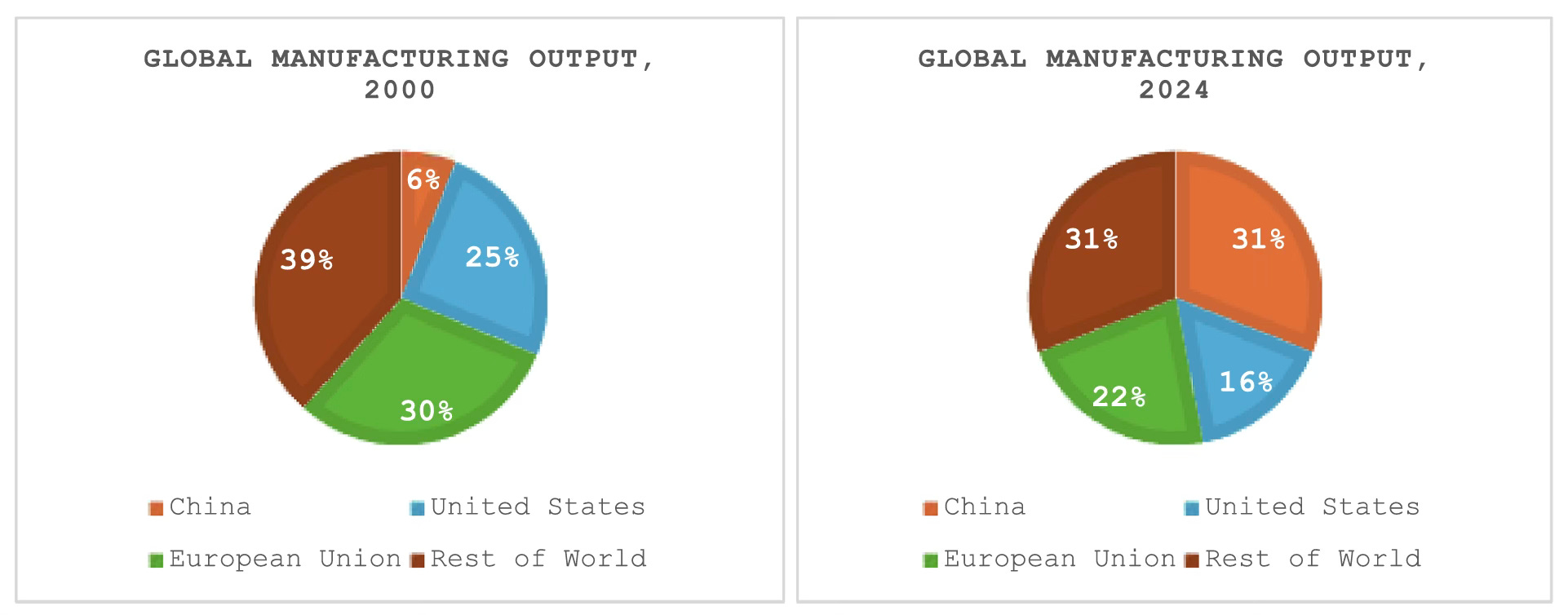
To support their arguments about neomercantilism, the researchers examined the growth in manufacturing output. The total manufacturing output of China, United States, and the EU made up approximately 61% of the total global manufacturing output in 2000, but in 2024, they made up 69%. This overall growth in the amount of concentration in manufacturing suggests that major powers have strengthened their economic dominance. This development crowds out other countries, preventing them from participating in global manufacturing output.
Shifting from a macro-analysis, the researchers also evaluate each superpower’s industrial policies individually. Although U.S. share of global manufacturing output has decreased in recent years, the authors still describe the national strategy as “hawkish.” Washington has utilized its economic toolbox to slow down Chinese production and engage in competition over economic dominance. Example of the United States’ policies include the extensive import and export controls and domestic subsidies in strategic sectors (like semiconductors and emerging technology). This “America First” approach is designed to facilitate the United States’ industrial capacity.
China has contributed the new wave of economic nationalism through its long-term persistence in industrial development. Policies such as the Made in China initiative, which supports key industries through subsidies and state-sponsored programs, grows China’s economic dominance. China has shifted from a labor-intensive and export-oriented economy to an innovation-led model. One notable policy that exemplifies their shift is China’s Fifteenth Five-Year Plan, an outline of China’s goals to rely on its own economy, enhance manufacturing, drive internal market growth, strengthen financial development, increase military capabilities, and boost long-term planning.2 These policies have increased China’s global manufacturing output byapproximately 25%.
The European Union has experienced increased competition internationally, with their global share of manufacturing decreasing from 30% to 22%. Instead of opting to restrict trade with China, they have taken a more cautious approach, maintainedtrade openness while also developed domestically. In 2024, EU-China trade has grown to approximately €213 billion, unlike other countries that have seen a significant decrease.3 Simultaneously, they have strengthened industrial policies, like the European Chips Act, an initiative to strengthen the semiconductor markets in the EU.
The authors conclude that national security and industrial policy have converged in recent years, transforming the global political economy. With China on a technological rise, powerful countries are competing for dominance in strategic industries. The increasing concentration of manufacturing power within China, the U.S., and the E.U. raises concerns about the ability for other nations to thrive economically, especially countries in the Global South. Returning to historical patterns, a modern paradigm of economic policy as national security has emerged.
Jostein Hauge, Bruno Houtzager, and Alessandro Julian Hörmann, “The New Economic Nationalism: Industrial Policy and National Security in the United States, China, and the European Union,” Geoforum 166 (2025): 104382, https://doi.org/10.1016/j.geoforum.2025.104382
Yilun Zhang. “China’s Fifteenth Five-Year Plan: Stability, Modernization, and the Strategic Logic behind Its Domestic Priorities.” ICAS, December 2, 2025. https://chinaus-icas.org/research/chinas-fifteenth-five-year-plan-stability-modernization-and-the-strategic-logic-behind-its-domestic-priorities/.
EU-China Trade: Facts and figures - consilium, August 8, 2025. https://www.consilium.europa.eu/en/infographics/eu-china-trade/.
